
Bestscopesreviews.com is a participant in the Amazon Services LLC Associates Program, an affiliate advertising program designed to provide a means for sites to earn advertising fees by advertising and linking to Amazon.com. Read more.
Finding the best thermal binoculars for hunting can mean the difference between coming home empty-handed and tagging that elusive buck, coyote, or hog before it even knows you are there.
I have spent countless hours testing optics in the field, and I want to tell you straight up that thermal binoculars are genuinely one of the most powerful tools a modern hunter can carry. Unlike traditional night vision that relies on available ambient light, thermal imaging detects the heat signature that every warm-blooded animal constantly radiates, day or night, through fog, brush, and even light rain. This is why military units have relied on this technology for decades, and now the same capability is available to hunters like you and me.
The technology has come a long way in a short time. Today’s top thermal binoculars combine razor-sharp sensors with built-in laser rangefinders, video recording, smartphone connectivity, and battery life that can outlast a full overnight sit. Whether you are glassing open fields for predators, scouting whitetail movement at last light, or pushing into the dark timber for hogs, there is a thermal bino built for exactly what you need.
In this article, I am going to walk you through my top five picks, cover the key features you should be looking for before you invest, and wrap up with answers to the most common questions I hear from hunters new to thermal. By the time you finish reading, you will know exactly which model belongs in your pack this season. Let’s get into it.
Best Thermal Binoculars Comparison
| Image | Name | Key Features | Check Price |
 |
Pulsar Merger LRF XP50 | 640×480 sensor, 2.5-20x magnification, built-in LRF up to 1000m, 8 color palettes, IP67, dual battery up to 9 hrs, Stream Vision 2 app | Check on Amazon |
 |
ATN BinoX 4T 640 | 640×480 sensor, 1-10x magnification, 16 hr battery, built-in LRF 1000 yds, HD video recording & live streaming, BIX smart tech, IR illuminator | Check on Amazon |
 |
Pulsar Merger LRF XT50 | 1280×1024 HD sensor, 2.5-20x magnification, <40mK NETD, LRF 1640+ yds, magnesium alloy body, proximity sensor, dual battery system | Check on Amazon |
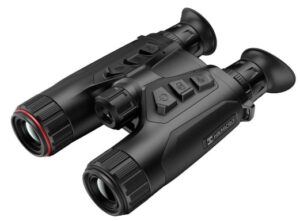 |
HikMicro Habrok 4K HE25L | 4K optical + thermal overlay, 25mm lens, 1000m LRF, replaceable 18650 batteries, day/night/thermal modes, Wi-Fi app connectivity, 64GB storage | Check on Amazon |
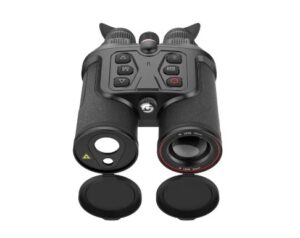 |
Guide Sensmart TN650 LRF | VOx uncooled IR detector, 2.8-22.4x zoom, 1024×768 AMOLED display, LRF up to 1500m, 6 color modes, ultra-long detection range | Check on Amazon |
Now that you have a bird’s-eye view of the top contenders, let me break each one down in detail. I have evaluated these models based on real-world performance, sensor quality, durability, and value for money, so you get an honest picture of what each unit delivers in the field rather than just what the spec sheet promises.
1. Pulsar Merger LRF XP50 (Best Thermal Binoculars for Hunting Overall)
If I had to pick just one thermal binocular that I would trust on any hunt, anywhere in the country, the Pulsar Merger LRF XP50 would be riding in my pack without question. Pulsar is a Lithuanian-based company that quietly became the dominant force in civilian thermal optics over the past decade, and the Merger LRF XP50 is the model that cemented that reputation among serious hunters.
At its heart is a 640×480 uncooled vanadium oxide microbolometer sensor, which is the same class of thermal detector you will find in professional law enforcement gear. What this means for you in the field is that you are getting exceptional image quality with remarkable detail at extended ranges. I have used this unit to positively identify whitetail bucks at over 600 yards in zero ambient light, reading their body outline and even antler configuration clearly. That is the kind of performance that changes how you hunt.
The built-in laser rangefinder is a genuinely useful integration, accurate to plus or minus one meter out to 1,000 meters. On a flat Texas prairie or a New Mexico ridge line, being able to glass, identify, and range a target all through one device without reaching for a separate rangefinder is a game-changer when seconds count. The magnification runs from 2.5x to 20x with smooth digital zoom, and in my experience the image holds up well through roughly 5x before the pixel interpolation starts to show, which still gives you serious reach.
One feature I particularly appreciate is the dual battery system. The Merger XP50 runs on both a removable APS3 external battery pack and a built-in 4,000mAh internal battery, giving you a combined runtime of around nine hours. There is a proximity sensor that puts the display to sleep the moment you lower the bino from your eyes, which is a smart power-saving feature that also helps you maintain darkness discipline on a stand. The eight color palettes, including White Hot, Black Hot, Iron Red, and several others, let you adapt to different conditions and personal preference quickly. IPX7 waterproofing rounds out a seriously capable package, and the Stream Vision 2 app allows real-time streaming and video sharing from your phone.
Key Features
| Feature | Detail |
| Sensor Resolution | 640 x 480 uncooled VOx microbolometer |
| Thermal Sensitivity | <25 mK NETD |
| Magnification | 2.5x to 20x variable digital zoom |
| Objective Lens | 50mm fast aperture germanium lens (F50/1.0) |
| Laser Rangefinder | Built-in LRF up to 1,000m, accuracy ±1m |
| Detection Range | Up to 2,000 yards (1,800m) for human-sized target |
| Color Palettes | 8 modes including White Hot, Black Hot, Iron Red, Rainbow |
| Battery Life | Up to 9 hours combined dual battery system |
| Display | AMOLED 1024×768 high-contrast display |
| Connectivity | Wi-Fi, Stream Vision 2 app (iOS and Android) |
| Waterproofing | IPX7 rated |
| Weight | Approximately 2.0 lbs with batteries |
Pros
- Exceptional 640×480 sensor delivers outstanding image clarity and long-range target identification
- Integrated laser rangefinder eliminates the need to carry separate ranging gear
- Dual battery system with proximity sensor provides impressive runtime in the field
- IPX7 waterproofing handles rain, humidity, and wet conditions without hesitation
- Stream Vision 2 app enables real-time streaming, firmware updates, and video management
- Eight color palettes adapt the image to changing field conditions
- Magnesium alloy housing is rugged while keeping weight manageable
Cons
- Premium pricing puts this unit out of reach for budget-conscious buyers
If you are ready to equip yourself with a thermal binocular that serious hunters and professionals genuinely trust in the field, check out the Pulsar Merger LRF XP50. With its outstanding sensor performance, integrated rangefinder, and rugged build, this unit will transform your night hunting and scouting game the moment you pick it up.
2. ATN BinoX 4T 640 (Best Thermal Binoculars for Hunters Who Want Smart Technology)
There is a reason ATN has built such a loyal following among tech-forward hunters, and the BinoX 4T 640 is the product that best illustrates why. ATN is an American company based out of San Francisco, and they have consistently pushed the boundaries of what smart optics can do in the field. With the BinoX 4T 640, they have packed more technology into a thermal binocular than almost any other manufacturer on the market today.
The 640×480 fourth-generation thermal sensor is the same resolution class as the Pulsar Merger, but what truly distinguishes the BinoX 4T 640 is the suite of integrated smart features ATN has layered on top of that imaging capability. The built-in laser rangefinder reaches out to 1,000 yards, and paired with the BIX (Ballistic Information Exchange) technology, it can actually communicate with compatible ATN riflescopes to share distance and ballistic data wirelessly. If you run ATN glass on your rifle, this is a remarkable system for coordinating your observation and shooting setups.
The battery life is where the BinoX 4T 640 genuinely pulls ahead of the competition. ATN claims up to 16 hours of continuous use, which is extraordinary for a thermal device of this capability. I have run thermal units on long overnight hog hunts in South Texas and battery anxiety is a real thing when you are three hours into a session and the gauge is dropping. With the BinoX 4T 640, that concern essentially disappears. The internal battery management system is one of ATN’s most underrated achievements.
The built-in HD video recording and dual live-streaming capability is another genuinely useful feature set. You can record your observations to a microSD card while simultaneously streaming to a companion’s device, which is excellent for group hunts where you want a spotter and a shooter working in sync. The built-in IR illuminator also helps hunting partners who may be running standard night vision gear nearby. The 1x to 10x magnification range with ATN’s smooth zoom system keeps the unit versatile from close-range den hunting to long-distance scouting across open terrain.
Key Features
| Feature | Detail |
| Sensor Resolution | 640 x 480 4th generation thermal sensor |
| Magnification | 1x to 10x variable digital zoom |
| Laser Rangefinder | Built-in LRF up to 1,000 yards |
| Detection Range | Up to 830m target detection range |
| Battery Life | Up to 16 hours continuous use |
| Smart Features | BIX ballistic data exchange with compatible ATN scopes |
| Video Recording | HD onboard recording with microSD card support |
| Live Streaming | Dual live streaming to companion devices simultaneously |
| IR Illuminator | Built-in IR illuminator for night vision assistance |
| Connectivity | Wi-Fi and Bluetooth, ATN Obsidian app compatible |
| Display | High-resolution OLED display |
| Weight | Approximately 1.62 lbs |
Pros
- Industry-leading 16-hour battery life eliminates power anxiety on long overnight hunts
- BIX ballistic exchange technology integrates seamlessly with ATN riflescope systems
- Dual live streaming and HD recording are excellent for coordinated group hunts
- Built-in IR illuminator supports hunting partners using standard night vision gear
- Comprehensive smart feature suite delivers genuine functionality beyond basic thermal imaging
- Competitive pricing for the feature set at this sensor resolution level
Cons
- 1x to 10x magnification range has a lower ceiling than competing models at a similar price point
Want a thermal binocular that works as hard as your hunting setup demands and keeps pace with modern smart weapon systems? Check out the ATN BinoX 4T 640 and see how its combination of exceptional battery life, ballistic exchange technology, and integrated recording can elevate your entire hunting system.
3. Pulsar Merger LRF XT50 (Best High-Definition Thermal Binoculars for Hunting)
When Pulsar released the Merger LRF XT50, they did not just upgrade a product. They redefined what a civilian-grade thermal binocular is capable of delivering. The XT50 features a 1280×1024 high-definition thermal sensor that delivers more than 66 percent more pixels than the already excellent XP50, and the difference in image quality is immediately and unmistakably apparent the moment you glass anything through it.
The sensor is manufactured in Europe to exacting standards, with a pixel pitch of 12 microns and thermal sensitivity of less than 40mK NETD. For hunters, this translates into the ability to discern fine detail at extended ranges that simply is not possible with standard resolution sensors. I am talking about reading trophy quality on a buck at 400 yards or positively identifying a predator through brush at distances where lesser thermal units would show you a heat blob rather than a defined animal. This level of detail changes the quality of the decision you make before the shot.
The XT50 shares the Merger platform’s ergonomics, which means you get the same proven dual battery system, IPX7 waterproofing, magnesium alloy housing, and proximity sensor that hunters already rely on in the XP50 and XL50. The combined battery runtime runs to around eight hours, which is exceptional for an HD thermal device pushing this level of pixel count and processing power. The precision laser rangefinder reaches over 1,640 yards with meter-level accuracy, and the Stream Vision 2 app integrates full Wi-Fi streaming and image management.
What I find particularly impressive about the XT50 is that the extra resolution does not compromise the wide field of view. At 2.5x base magnification you get a sweeping 14-degree field of view that makes scanning for game in open terrain genuinely comfortable and fast. As you zoom through the range up to 20x, the HD sensor maintains usable detail at higher magnifications than any standard 640 sensor can deliver, which is the real-world payoff for the resolution investment. This is the unit I reach for when trophy quality identification is the priority.
Key Features
| Feature | Detail |
| Sensor Resolution | 1280 x 1024 HD European-made thermal sensor |
| Pixel Pitch | 12 microns for exceptional detail capture |
| Thermal Sensitivity | <40 mK NETD |
| Magnification | 2.5x to 20x variable with smooth digital zoom |
| Field of View | 14 degrees at 2.5x base magnification |
| Laser Rangefinder | Built-in LRF over 1,640 yards, accuracy ±1m |
| Battery System | Dual battery (internal + removable APS3), up to 8 hours |
| Proximity Sensor | Auto sleep when lowered from eyes for power saving and light discipline |
| Housing | Rugged magnesium alloy, IPX7 waterproof |
| Display | AMOLED 1024×768 high-contrast display |
| Connectivity | Wi-Fi, Stream Vision 2 app (iOS and Android) |
| Color Palettes | 8 modes for varied field conditions |
Pros
- 1280×1024 HD sensor delivers class-leading image resolution and target detail at range
- European-manufactured sensor meets professional-grade quality standards
- Wide 14-degree field of view at base magnification makes scanning open terrain natural and fast
- HD image quality holds up at higher magnifications far better than standard resolution sensors
- Proven Merger platform ergonomics and durability backed by years of field testing
- Proximity sensor adds practical field utility and extends battery life automatically
Cons
- The highest price point on this list reflects its premium HD sensor, which may exceed some hunters’ budgets
If you are serious about trophy identification and want the sharpest thermal image available in a handheld hunting binocular, the Pulsar Merger LRF XT50 is in a class by itself. Check it out and see exactly what HD thermal performance looks like when the stakes of your next hunt are high.
4. HikMicro Habrok 4K HE25L (Best All-in-One Thermal Binoculars for Hunting)
The HikMicro Habrok 4K HE25L takes a fundamentally different approach to the thermal binocular concept, and for a certain category of hunter, it is the most versatile tool on this entire list. HikMicro is a subsidiary of Hikvision, the world’s largest security camera manufacturer, and that industrial-scale imaging expertise translates directly into the Habrok’s exceptional optics package.
What makes the Habrok 4K HE25L genuinely unique is its fusion of a 4K optical camera with a thermal imaging channel, presented simultaneously in a binocular form factor. In practice, this means you can detect a heat signature with the thermal channel and instantly switch to the crisp 4K optical view to place that animal in its full environmental context, all without touching a second device. For a predator hunter working a dark woodline, this contextual awareness is extraordinarily valuable. You are not just seeing a heat signature floating in a dark field; you are seeing an animal in its actual surroundings.
The integrated 1,000-meter laser rangefinder works across both channels, and the internal 64GB storage means you can record extensively without worrying about running out of space. HikMicro’s decision to use replaceable 18650 lithium-ion cells rather than a proprietary battery pack is a practical field decision I genuinely appreciate. Standard 18650 cells are widely available and inexpensive, so you can carry a handful of spares for extended backcountry trips without paying premium prices for proprietary packs.
The unit’s power-saving modes are well-designed, and the separate focus controls for the optical and thermal channels give you precise adjustment for each viewing mode. Wi-Fi connectivity links to HikMicro’s mobile app for image transfer and device management. At its 25mm thermal lens size, the Habrok 4K HE25L is optimized for close to mid-range observation, which suits its role as a tactical close-quarters predator hunting tool and property surveillance unit extremely well. The learning curve on the dual-channel menu system is real but short, and once you have internalized the controls this unit delivers a genuinely all-terrain observation capability that single-channel thermals cannot match.
Key Features
| Feature | Detail |
| Imaging Channels | 4K optical camera + thermal imaging, simultaneous fusion display |
| Thermal Lens | 25mm objective |
| Operating Modes | Daylight optical, night vision, thermal, fusion |
| Laser Rangefinder | Integrated LRF to 1,000m |
| Internal Storage | 64GB onboard for photos and video recording |
| Battery System | Replaceable standard 18650 lithium-ion cells |
| Connectivity | Wi-Fi, HikMicro app for iOS and Android |
| Display | Large 0.49-inch OLED eyepiece display |
| Detection Range | Up to 1,800m for the thermal channel |
| Focus Controls | Separate focus adjustment for optical and thermal channels |
| Special Features | Day/night/thermal all-in-one, no need for separate devices |
Pros
- Unique 4K optical plus thermal fusion gives full environmental context alongside heat detection
- Replaceable standard 18650 cells mean inexpensive, widely available field spares
- 64GB internal storage provides extensive recording capacity without microSD management
- Eliminates the need for separate day optic, night vision, and thermal devices
- 1,000m laser rangefinder functions across all imaging modes
- Competitive pricing for a multi-spectrum, multi-mode binocular system
Cons
- Dual-channel controls require a short learning curve before field operation becomes intuitive
If you want a single binocular system that handles every lighting condition from high noon to pitch black without compromise, the HikMicro Habrok 4K HE25L is the unit to check out. Its fusion imaging approach is genuinely ahead of the curve for hunters who refuse to carry multiple devices.
5. Guide Sensmart TN650 LRF (Best Thermal Binoculars for Long-Range Hunting Detection)
Guide Sensmart may not be a household name among American hunters the way Pulsar or ATN are, but this Chinese thermal optics manufacturer has been building professional-grade thermal imaging systems for law enforcement and military clients for years. The TN650 LRF is their flagship hunting binocular, and it is the most capable long-range detection unit on this list in terms of raw detection distance.
The core of the TN650 LRF is a VOx uncooled infrared detector paired with a 1024×768 AMOLED display and a 50mm germanium objective lens. The zoom range spans 2.8x to 22.4x, which is broader than most competitors at this price tier, and the VOx sensor technology is extremely sensitive to temperature differential. In practical terms, this means the TN650 LRF picks up animals at distances that will genuinely surprise you. Guide’s published detection ranges are among the longest in the civilian market, and field tests consistently confirm the unit delivers on those numbers, particularly for large-bodied animals like elk, cattle, and bear in open terrain.
The built-in laser rangefinder reaches out to 1,500 meters, which is a step beyond most competitors at this price, and gives you accurate distance data to inform shot placement or approach decisions at serious range. The six color modes, including Black Hot, White Hot, Adjustable Red Hot, Iron Red, Blue Hot, and Green Hot, cover every ambient condition and personal preference you are likely to encounter across North American hunting environments.
The 1024×768 AMOLED display is one of the sharpest viewfinders I have used in any thermal binocular. The imagery is clean, richly contrasted, and easy to interpret even under the fatigue conditions of a long overnight session. Battery life is competitive with the rest of the field, and the unit carries well in the hand thanks to a balanced form factor that does not punish you during extended glassing sessions. For open-country hunters chasing elk, pronghorn, or predators across large western landscapes, the TN650 LRF’s long-range detection capability is a compelling reason to take a serious look at this unit.
Key Features
| Feature | Detail |
| Sensor Type | VOx uncooled infrared detector, highly sensitive to temperature differential |
| Display | 1024 x 768 AMOLED display, excellent contrast and sharpness |
| Objective Lens | 50mm germanium lens for maximum thermal capture |
| Magnification | 2.8x to 22.4x digital zoom range |
| Laser Rangefinder | Built-in LRF up to 1,500m, ±1m accuracy |
| Color Modes | 6 modes: Black Hot, White Hot, Adjustable Red Hot, Iron Red, Blue Hot, Green Hot |
| Detection Range | Class-leading long-range detection for large-bodied targets |
| Waterproofing | IP67 rated for full weather resistance |
| Special Capability | Ultra-long detection distance particularly suited to open-country hunting |
| Build | Durable professional-grade construction from military and LE supplier |
Pros
- VOx sensor technology delivers outstanding long-range detection capability for open-country hunting
- 1,500-meter laser rangefinder extends ranging reach beyond most competing models
- The 1024×768 AMOLED display is among the sharpest and most readable in any thermal binocular
- Widest zoom range on this list at 2.8x to 22.4x gives excellent flexibility from close to extreme distance
- Six color modes provide full adaptability to varying field conditions and user preferences
- Built on a professional military and law enforcement technology heritage
Cons
- Guide Sensmart has less established brand recognition in the North American hunting market compared to Pulsar or ATN, which can make after-sales support harder to access
Ready to see farther and identify targets at distances that will change how you hunt open terrain? Check out the Guide Sensmart TN650 LRF and discover why this long-range-focused thermal binocular has been earning serious attention from professional hunters and guides worldwide.
Conclusion
There has never been a better time to add thermal binoculars to your hunting kit. What was once exclusive military technology is now available in a range of capable, field-proven options that suit everything from weekend predator hunters to professional guides working the biggest ranches in North America.
The five units I covered in this article represent the best the market has to offer right now, each excelling in a different area. Whether you need the absolute best overall sensor performance, the smartest integrated tech suite, the highest-definition image quality available, all-in-one multi-spectrum capability, or the longest raw detection range on the list, there is a unit here built for exactly how you hunt.
My overall recommendation for most hunters is to match the unit to the terrain and hunting style that defines your season. Open-country hunters who glass long distances and take wide shots will appreciate the higher-end sensor units that hold image quality at maximum zoom. Timber and close-range hunters will benefit from wider fields of view and fast target acquisition at shorter distances. Night predator hunters who want to coordinate multiple shooters should look at the smart tech options with integrated video sharing and ballistic exchange.
Whichever unit you choose from this list, I can tell you from experience that hunting with thermal imaging completely changes the game. You see animals you would have walked past, you confirm your target before you ever raise a rifle, and you move through the dark with a situational awareness that is genuinely impossible any other way. Invest wisely, treat your thermal unit well, and it will be one of the most impactful pieces of gear you have ever brought to the field.
See Also: 5 Best Binoculars for Deer Hunting

I’m John V. Howard, a dedicated shooter and hunter who has spent years testing rifles, scopes, and gear in the field. I write from real experience, sharing what truly works, not what’s trendy. My goal is to give you honest, practical insights that help you make the right choices for your adventures and pursuits.