Bestscopesreviews.com is a participant in the Amazon Services LLC Associates Program, an affiliate advertising program designed to provide a means for sites to earn advertising fees by advertising and linking to Amazon.com. Read more.
If you are on the market for the best thermal binoculars for hunting, you already have one major advantage over every hunter who came before you: the technology is better, more accessible, and more affordable than it has ever been.
I have spent years in the field testing optics and working alongside experienced hunters and firearms professionals, and I can tell you without hesitation that thermal binoculars are one of the most transformative tools you can add to your hunting kit.
They do not care whether it is pitch black, foggy, or raining. They detect heat, which means that buck bedded in the brush, that hog rooting through the corn field, or that coyote circling your decoys is visible to you, no matter what the conditions throw at you.
In this guide, I am going to walk you through five of the top thermal binoculars available for hunting today, covering what makes each one exceptional in the field, who each one is built for, and what you need to know before you buy.
Best Scopes Comparison
| Image | Name | Key Features | Check Price |
|---|---|---|---|
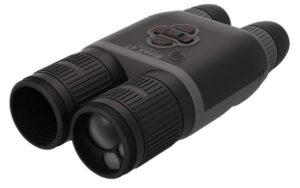 |
ATN BinoX 4T 640 1.5-15x Thermal Binoculars | 4th Gen 640×480 sensor, 1.5-15x magnification, 16-hour battery, 1,000-yard detection, built-in LRF, Wi-Fi, video recording | Check Price |
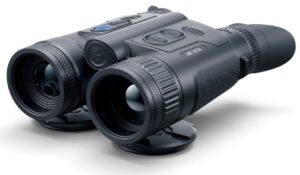 |
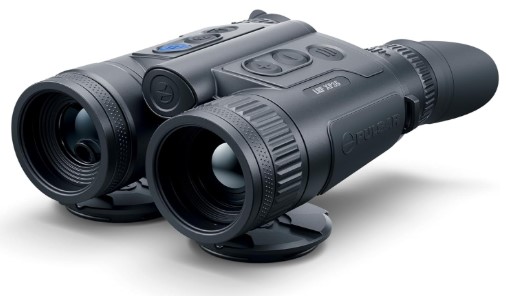
Pulsar Merger LRF XP35 Thermal Binoculars | 640×480 sensor, less than 25mK NETD, 17.8-degree FOV widest in class, 2-16x magnification, built-in LRF, compact magnesium body | Check Price |
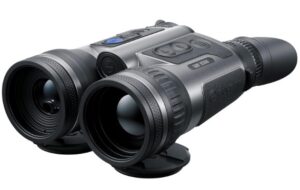 |
Pulsar Merger LRF XT50 Thermal Binoculars | HD 1280×1024 sensor, 12um pixel pitch, 2-16x magnification, 17.5-degree FOV, digital stabilization, 2,300-yard detection, IPX7 rated | Check Price |
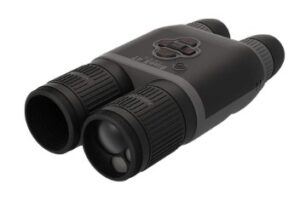 |
ATN BinoX 4T 384 Smart HD Thermal Binoculars | 384×288 sensor, 1.25-5x magnification, BIX ballistic integration, built-in LRF and IR illuminator, GPS animal tagging, live streaming | Check Price |
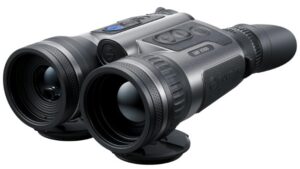 |
Pulsar Merger LRF XL50 Thermal Binoculars | HD 1024×768 sensor, 2.5-20x magnification, 2,000-yard detection, AMOLED microdisplay, dual battery system, Stream Vision 2 app | Check Price |
Whether you are running hogs in South Texas, calling coyotes in the open prairies, or still-hunting whitetails through thick timber, there is a thermal binocular in this list built specifically for the way you hunt. Let us break down what each one brings to the field and figure out which one deserves a spot in your pack.
1) ATN BinoX 4T 640 1.5-15x Thermal Binoculars (Best Thermal Binoculars for Hunting Overall)
If I had to pick one thermal binocular that covers the widest range of hunting scenarios without making you compromise on anything important, the ATN BinoX 4T 640 is the one I keep coming back to. ATN has built a genuine reputation in the thermal and smart optics space, and this binocular is the clearest expression of what the company does best: take military-grade detection technology and wrap it in a feature set that actively helps you hunt more effectively.
At the heart of the BinoX 4T 640 is a 4th generation 640×480 thermal sensor, and that resolution is a big deal for hunters specifically. A 640 sensor has four times the pixel density of a 320 or 256 sensor, and in practical terms that means you are seeing real detail the kind of detail that lets you confirm whether that heat signature 250 yards away is a spike buck or a shooter before you make your move.
The 1.5x to 15x magnification range is one of the most versatile in the thermal binocular category and is genuinely well matched to hunting. At 1.5x you are covering a wide field that is perfect for scanning a bean field or a sendero at first light, picking up movement across a big area fast.
Dial up to 10x or 15x and you are studying a target in serious detail, checking antler character, looking for pigs with piglets (illegal to shoot in most states if she is nursing), or confirming that what you saw move into the brush is actually worth pursuing. This flexibility means the BinoX 4T 640 is equally at home on a South Texas hog lease, a Midwestern whitetail property, and open country predator setups a true do-everything hunting thermal.
ATN designed the BinoX 4T 640 with the concept of the fully integrated hunting system in mind. The built-in 1,000-yard laser rangefinder feeds distance data directly into the display. The on-board compass keeps you oriented in the dark. The GPS lets you tag animal locations so you can map their movement patterns through the ATN app on your smartphone, which connects over Wi-Fi for live streaming and footage sharing.
The built-in IR illuminator actively helps hunting partners who are running night vision devices stay locked onto the same target you are observing through the thermal, a feature that is surprisingly practical when you are hunting with a buddy who is covering you with a thermal-equipped rifle.
The battery life is where this binocular genuinely separates itself from the competition. Sixteen hours of continuous operation is a figure that almost no other thermal binocular in this class can match. For hunters who run from dusk to dawn and want to hunt the last hour of shooting light the following evening without scrambling for a charge, that battery runtime changes the planning calculus completely.
Yes, the BinoX 4T 640 is on the heavier side at 2.5 pounds, but for everything it delivers across a full hunting season, that is a trade most hunters will accept without much argument.
Key Features
| Feature | Specification |
|---|---|
| Thermal Sensor | 4th Gen 640×480 |
| Magnification | 1.5-15x |
| Detection Range | 1,000 yards |
| Identification Range | 300 yards |
| Battery Life | 16+ hours |
| Built-in Features | LRF, IR illuminator, compass, GPS, Wi-Fi, video recording at 1280×960 |
| Weight | 2.5 lbs |
Pros
- A 16-plus hour battery life is unmatched in this class and eliminates the risk of losing power during an all-night hunt or a multi-night trip without reliable charging access
- The 4th generation 640×480 sensor delivers the resolution needed to positively identify game at 300 yards, which is a critical capability for ethical shot decisions in the dark
- A 1.5-15x magnification range covers nearly every realistic hunting scenario from close-cover deer hunting to open-country predator calling without requiring a second optic
- The fully integrated smart hunting system — GPS tagging, LRF, IR illuminator, ballistic tools, and live streaming — makes this a true hunting command center rather than just a passive viewer
Cons
- At 2.5 pounds it is heavier than most thermal binoculars in its class, which becomes noticeable during extended glassing sessions or long pack-in hunts where every ounce matters
If you want a thermal binocular that is ready for any hunting situation you can throw at it and that works as an active part of your hunting system rather than just a passive viewer, this is the one to have in your pack. Check it out and see why it earns top marks from hunters across nearly every discipline of the sport.
2) Pulsar Merger LRF XP35 Thermal Binoculars (Best Thermal Binoculars for Hunting in Dense Cover)
Let me tell you something that experienced whitetail and wild boar hunters already know: in heavy timber and dense cover, a wide field of view is worth more than raw magnification or even detection range. When an animal steps out of the brush at 60 yards, and you have three seconds to confirm what it is before it vanishes back into the dark, you need the widest possible view available so nothing slips through the cracks.
That is exactly what the Pulsar Merger LRF XP35 was built to deliver — and it does so in a package that is genuinely compact and comfortable for extended hunting sessions.
The headline specification of the XP35 is its 17.8-degree field of view, which Pulsar correctly advertises as the widest in-class field of view not just among their own lineup but across the entire thermal binocular market. That statement held up as of the XP35’s debut at the Outdoor Classics trade show in 2024, and it is a number that resonates clearly when you are behind the eyepieces in the field.
Three European hunters who reviewed the XP35 during field trials specifically called out the field of view as the defining feature of the binocular, with one Swedish wild boar hunter noting that the wide view at close range was far more useful in his conditions than any mid-range detection capability would be. That is real-world validation from people who hunt seriously in exactly the terrain this binocular is optimized for.
Despite its compact form factor, the XP35 is powered by the same high-performance XP sensor that drives Pulsar’s larger Merger models. The 640×480 resolution sensor features a 17 micrometer pixel pitch and an NETD rating of less than 25 millikelvin, which is the same elite sensitivity specification found in instruments used by professional security operators.
What that means for hunting is that in cold, foggy, or rainy conditions where the contrast between a deer’s body heat and the cool background is reduced, the XP35 is still detecting what less sensitive sensors miss. Target detail recognition reaches out to nearly 1,500 yards even in adverse weather — impressive for a 35mm objective lens-class binocular.
The build follows Pulsar’s proven Merger chassis: a magnesium alloy body that is solid, flex-free, and sized to fit naturally in the hand during extended observation. The dual battery system combines a built-in 4,000mAh cell with a removable APS3 3,200mAh pack, and the removable battery is field-swappable, meaning you can carry a spare and extend your operating time indefinitely when the situation demands it.
Interpupillary distance adjusts between 63mm and 74mm to fit a wide range of users comfortably. Wi-Fi connectivity and Stream Vision 2 app compatibility provide live viewing, footage sharing, and firmware management from a smartphone. For the hunter who spends most of their time in tight timber, creek bottoms, or brushy river country, this is the thermal binocular built specifically for your terrain.
Key Features
| Feature | Specification |
|---|---|
| Thermal Sensor | 640×480, 17um pixel pitch, less than 25mK NETD |
| Field of View | 17.8 degrees (widest in class) |
| Magnification | 2-16x |
| Laser Rangefinder | Up to 1,000 meters, single and scanning modes |
| Body | Magnesium alloy, compact form factor |
| Battery | Dual system: 4,000mAh built-in plus removable APS3 3,200mAh |
| Connectivity | Wi-Fi, Stream Vision 2 app (iOS and Android) |
Pros
- The 17.8-degree field of view is the widest available in the thermal binocular category and gives hunters in dense cover a decisive advantage when animals appear at close range with little warning
- The less than 25mK NETD sensor sensitivity ensures reliable target detection even in cold, foggy, and rainy conditions where lower-sensitivity sensors start to struggle
- The dual removable and built-in battery system allows field battery swaps for unlimited runtime during extended hunts
- The compact magnesium alloy chassis is lightweight and easy to hold steady during long glassing sessions without the fatigue that heavier units cause
Cons
- The 35mm objective lens gives up some detection range compared to 50mm-class models in the Merger lineup, making it less ideal for hunters who regularly work at very long distances in open terrain
For close-quarters hunting in dense cover where speed of target acquisition and width of field of view are the most critical factors, this is the thermal binocular that was purpose-built for your situation. Check it out and see why hunters who live and hunt in heavy timber consistently rank it among the best thermal binoculars available.
3) Pulsar Merger LRF XT50 Thermal Binoculars (Best HD Thermal Binoculars for Hunting)
There is a moment that every serious hunter with a thermal binocular has experienced — the moment where you are not quite sure what you are looking at. Is that smear of heat a coyote or a raccoon? Is that deer a doe or a buck worth putting a tag on? Is that hog traveling alone or with piglets? With a standard 640×480 thermal sensor those questions can genuinely linger, particularly at distance.
The Pulsar Merger LRF XT50 eliminates that uncertainty almost entirely by delivering an HD 1280×1024 thermal sensor, and the difference in identification capability at distance is not subtle — it is dramatic, and hunters who have used it consistently describe it in almost the same words: jaw-dropping.
The 1280×1024 sensor in the XT50 delivers more than 66 percent more pixels than the previous top-of-the-line Merger model, and that extra resolution translates directly into identification capability at distances that would leave a standard 640-class sensor showing you a fuzzy blob.
During field testing, hunters were confirming antler character on deer at distances where other binoculars left serious doubt, spotting piglets traveling with sows at ranges that made the legal harvest decision clear and confident, and observing small predators like foxes and raccoons at distances where positive identification would have been difficult with lesser optics. One field tester described picking up two rabbits at 250 to 400 meters as “two white pixels” — a demonstration of how sensitive this sensor is even at distances where thermal performance starts to challenge lesser units.
The XT50 also introduces digital image stabilization to the Merger line, and this feature is genuinely impactful during actual hunting use. When you have been on your feet for eight hours and you are trying to hold a 2.5-pound binocular steady at 16x magnification to confirm a target before you make a move, image stabilization smooths the picture in a way that reduces eye fatigue and improves the reliability of your target assessment.
The 17.5-degree field of view is wide enough for comfortable scanning despite the HD resolution, and the 2x to 16x magnification range gives you the flexibility to survey open areas and then zoom in on targets of interest without changing your position.
The detection range of the XT50 extends to approximately 2,300 yards, and the integrated laser rangefinder measures accurately out to 1,600 yards. The dual battery system provides up to 8 hours of use, which is solid for most hunting nights, and the removable APS3 pack can be swapped in the field for extended operations.
The magnesium alloy body carries an IPX7 waterproof rating, meaning it can be submerged in up to three feet of water for 30 minutes. Stream Vision 2 app connectivity provides live viewing and footage sharing capability. If you hunt seriously and the absolute clarity of target identification is the single most important factor in your binocular choice, this is the instrument that delivers it.
Key Features
| Feature | Specification |
|---|---|
| Thermal Sensor | HD 1280×1024, 12um pixel pitch |
| Magnification | 2-16x |
| Field of View | 17.5 degrees |
| Detection Range | Approximately 2,300 yards |
| Laser Rangefinder | Up to 1,600 yards, single and scanning modes |
| Digital Stabilization | Yes (first in the Merger line) |
| Battery | Dual system, up to 8 hours |
| Waterproofing | IPX7 rated |
| Connectivity | Wi-Fi, Stream Vision 2 app (iOS and Android), 16GB cloud storage |
Pros
- The HD 1280×1024 sensor delivers more than 66 percent more resolution than standard 640-class sensors, giving hunters a dramatically sharper image that makes positive target identification reliable at distances where other binoculars leave you guessing
- Digital image stabilization is a first for the Merger line and makes a meaningful practical difference when holding at extended magnification after a long day in the field
- A 2,300-yard detection range combined with the clarity of the HD sensor makes this one of the most capable hunting observation tools available
- IPX7 waterproof rating provides genuine field confidence across all weather conditions, including submersion
Cons
- The premium price of this HD-class instrument reflects its exceptional sensor and build quality, placing it at the higher end of the thermal binocular investment range and making it best suited for committed, serious hunters who will use it consistently
When hunters who test it for the first time consistently respond with dropped jaws, that is not a marketing outcome — that is real performance. If you want the clearest, most detailed thermal hunting view available without stepping into military-contractor pricing, check this one out. You will understand immediately why it is the benchmark HD thermal binocular for hunters.
4) ATN BinoX 4T 384 Smart HD Thermal Binoculars (Best Thermal Binoculars for Hunting Predators and Hogs)
Predator hunting and hog control are two of the fastest-growing nocturnal hunting activities in North America right now, and they share a common set of demands that set them apart from most other forms of hunting. The animals come in fast and unpredictably, often in groups, usually at close to medium range, and the window between “they are coming in” and “they are gone” can be measured in seconds.
A thermal binocular built for these scenarios needs to prioritize speed of target acquisition, wide situational awareness, and a technology ecosystem that lets you coordinate efficiently with a hunting partner. The ATN BinoX 4T 384 Smart HD is built with exactly these priorities in mind, and it shows in every feature decision the engineers made.
The 384×288 thermal sensor sits at the sweet spot between price and performance for predator and hog hunting specifically. At the distances where most predator calling shots happen — typically between 30 and 300 yards — a 384 sensor delivers more than adequate resolution for confident target identification, and it does so at a price point that keeps the overall investment reasonable without sacrificing the capabilities that actually matter for this style of hunting.
The magnification range of 1.25x to 5x is deliberately wide-angle-focused, and that is exactly right for predator work. When a coyote appears from an unexpected direction at 80 yards while you are scanning a different part of the field, you need wide situational awareness to catch the movement quickly. A narrow, high-magnification thermal binocular in predator hunting is a liability more than an asset.
What genuinely sets the BinoX 4T 384 apart from all other thermal binoculars in the hunting segment is the ATN BIX (Ballistic Information Exchange) technology. Here is how it works in the field: you range a hog at 180 yards with the built-in 1,000-meter laser rangefinder.
That range data transmits automatically to your ATN thermal-equipped rifle scope, which calculates the correct holdover point for your specific load and ambient conditions. The scope displays the corrected aiming point, and you make the shot without any manual calculation or reference to a ballistic chart in the dark. That is a closed-loop hunting technology system that genuinely reduces the chance of a poor hit and increases the effectiveness of every shot you take after dark.
Beyond the ballistic integration, the BinoX 4T 384 includes a built-in IR illuminator that actively helps a hunting partner running night vision devices stay locked onto the target you are watching through the thermal. You can tag animal locations via GPS so they show up as waypoints in the ATN app — invaluable for tracking hog movement patterns across multiple nights on a property.
Live streaming lets you share what you are seeing with a spotter who cannot see the screen. The compass and directional data keep you oriented, which matters more than you might think when you have been spinning to call coyotes from multiple directions in the dark. This is a binocular that understands predator and hog hunting at a systems level, not just as a detection tool.
Key Features
| Feature | Specification |
|---|---|
| Thermal Sensor | 384×288 |
| Magnification | 1.25-5x |
| Laser Rangefinder | Up to 1,000 meters |
| Special Technology | BIX ballistic information exchange with compatible ATN scopes |
| Built-in Features | Compass, GPS, IR illuminator, video recording, live streaming |
| Connectivity | Wi-Fi, ATN app (iOS and Android) |
| Best For | Predator calling, hog control, fast close-range target acquisition |
Pros
- The BIX ballistic information exchange system is a genuine tactical advantage for hunters running ATN scopes, automatically feeding rangefinder data to the scope and eliminating manual holdover calculation in the dark
- The 1.25-5x magnification range is purpose-built for predator and hog hunting, prioritizing wide situational awareness and fast target acquisition over high magnification
- The built-in IR illuminator is a practical feature for coordinated team hunts where multiple hunters are using a combination of thermal and night vision devices
- GPS-based animal location tagging creates a map of nocturnal activity across your hunting property over multiple nights, which is invaluable for property management and strategic hunt planning
Cons
- The full value of the BIX ballistic integration is only realized when paired with a compatible ATN smart scope on your rifle, so hunters running non-ATN riflescopes will not get the automatic holdover calculation feature
Predator and hog hunting rewards preparation, coordination, and the right technology working together as a system. This binocular was built for exactly that. Check it out and see how much more effective your next night hunt can be when your optics are actually talking to each other.
5) Pulsar Merger LRF XL50 Thermal Binoculars (Best Thermal Binoculars for Hunting Open Country)
Open-country hunting presents a fundamentally different set of demands from hunting in timber or brush. When you are glassing mule deer on a Nevada ridge, scanning a Texas sendero that runs for half a mile, or watching a wheat field at last light in Kansas, the metric that matters most is not field of view or close-range target acquisition speed — it is detection range, image detail at distance, and the kind of optical quality that lets you distinguish trophy antlers from average ones at 600 yards in the dark. The Pulsar Merger LRF XL50 was built for exactly this application, and it represents one of the highest levels of thermal performance available to civilian hunters on the market today.
The XL50 runs a high-definition 1024×768 thermal sensor with a 17 micrometer pixel pitch, and this sensor is reproduced by a paired AMOLED microdisplay at the same 1024×768 resolution. The significance of that 1:1 ratio between sensor and display is that you are seeing every pixel the sensor captures without any upscaling, interpolation, or image degradation from resolution mismatching.
What the sensor sees, you see — with perfect fidelity. Reviewers who have put this binocular side by side with other thermal units at a distance consistently describe the image quality as something that has to be seen to be fully appreciated, with one professional reviewer stating it is the absolute finest thermal imaging binocular available outside of military-contractor products.
The detection range reaches out to 2,000 yards, which is well beyond what most open-country hunters will ever practically need, giving you a comfortable buffer of capability for the most demanding real-world glassing situations.
The magnification range runs from 2.5x at the native base up to 20x via 8x digital zoom, and the quality of the image at maximum magnification is one of the areas where the HD sensor truly shines. With a standard 640×480 sensor, heavy digital zoom produces a noticeably degraded image.
With the XL50’s 1024×768 sensor, the image at 20x magnification is described as comparable in clarity to what a 640-class binocular delivers at 10x — a level of zoom performance that opens up identification possibilities that simply do not exist with lower-resolution thermal sensors.
The build follows Pulsar’s proven Merger format: magnesium alloy chassis with intuitive six-button control layout and adjustable interpupillary distance between 62mm and 74mm. The proximity sensor automatically dims the displays when the binocular is lowered from your eyes, conserving battery and preventing light discipline issues in the dark.
The laser rangefinder measures distance accurately out to 1,000 meters in both single-shot and continuous scanning modes. The dual battery system — one built-in 4,000mAh cell plus a removable APS3 pack — delivers solid operating time with the option to carry a spare pack for all-night operations.
Stream Vision 2 app connectivity handles live streaming, footage transfer, and firmware updates over Wi-Fi. For the serious open-country hunter who demands the best possible thermal image at distance, the XL50 is the benchmark against which every competitor is measured.
Key Features
| Feature | Specification |
|---|---|
| Thermal Sensor | HD 1024×768, 17um pixel pitch |
| Display | AMOLED 1024×768 microdisplay (1:1 sensor to display ratio) |
| Magnification | 2.5-20x (8x digital zoom) |
| Detection Range | 2,000 yards |
| Laser Rangefinder | Up to 1,000 meters, single and scanning modes |
| Battery | Dual system: 4,000mAh built-in plus removable APS3 pack |
| Connectivity | Wi-Fi, Stream Vision 2 app, 16GB cloud storage |
| Special Features | Proximity sensor display auto-off, adjustable interpupillary distance 62-74mm |
Pros
- The HD 1024×768 sensor reproduced at a perfect 1:1 ratio by the AMOLED microdisplay delivers an image quality that reviewers consistently describe as the benchmark standard for civilian thermal binoculars
- A 2,000-yard detection range combined with 20x magnification makes this one of the most capable open-country glassing tools available at any price point
- The image quality at maximum digital zoom is comparable to what a 640-class sensor delivers at half the magnification, opening up identification possibilities that standard thermal binoculars simply cannot match
- The proximity sensor auto-off feature is a genuinely useful hunting tool that conserves battery life and maintains light discipline without requiring any manual input
Cons
- The premium price of this HD-class instrument reflects its exceptional sensor and optical quality and represents the higher end of the thermal binocular investment range, making it best suited for dedicated open-country hunters who spend significant time behind glass every season
When professional reviewers describe something as the absolute best thermal binocular available outside of military equipment, that is a statement worth paying attention to. If open-country big game hunting is your passion and you want the finest thermal image available when you are glassing in the dark, check this one out — it will redefine your expectations of what thermal technology can do for your hunting.
Conclusion
Thermal binoculars have changed the way serious hunters approach the night, and the five options I covered in this guide represent the very best of what this technology offers across a range of hunting styles, terrains, and budgets.
Whether your priority is a battery that outlasts even the longest all-night hunt, an HD sensor that gives you the identification confidence to make ethical decisions on game at distance, the widest field of view available for fast close-range target acquisition in thick cover, a smart hunting system that coordinates your binoculars and rifle scope into a single connected workflow, or the finest open-country thermal image that civilian money can buy, there is a clear and compelling choice in this lineup for the way you hunt.
The animals that used to slip away in the dark no longer have that advantage. These binoculars take it from them — and hand it directly to you.
See Also: 5 Best Thermal Binoculars for the Money

I’m John V. Howard, a dedicated shooter and hunter who has spent years testing rifles, scopes, and gear in the field. I write from real experience, sharing what truly works, not what’s trendy. My goal is to give you honest, practical insights that help you make the right choices for your adventures and pursuits.