
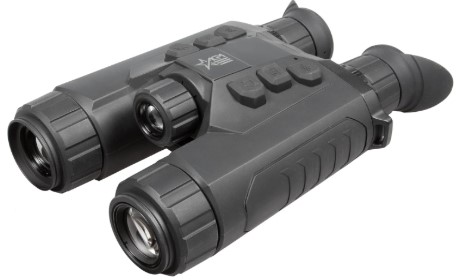
Bestscopesreviews.com is a participant in the Amazon Services LLC Associates Program, an affiliate advertising program designed to provide a means for sites to earn advertising fees by advertising and linking to Amazon.com. Read more.
If you are on the market for the best thermal binoculars for the money, you already know how game-changing this technology is and how overwhelming the options can get. I have been around firearms and optics for a long time, and I can tell you that thermal binoculars are genuinely one of the most powerful tools a hunter, shooter, or outdoor professional can own.
Unlike night vision that depends on ambient light, thermal imaging reads heat signatures, which means you can spot a hog, coyote, or deer in total darkness, through fog, and even through light brush.
The technology has come down in price significantly over the last few years, and there are now some outstanding options that deliver serious performance without completely draining your bank account.
In this guide, I am going to walk you through five of the best thermal binoculars available right now, covering what each one does well, what to watch out for, and who each one is best suited for.
Best Scopes Comparison
| Image | Name | Key Features | Check Price |
|---|---|---|---|
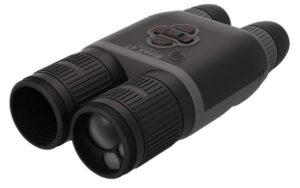 |
ATN BinoX 4T 640 1.5-15x Thermal Binoculars | 640×480 4th gen sensor, 1.5-15x magnification, 16-hour battery, 1,000-yard detection, built-in LRF, video recording | Check Price |
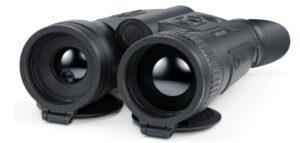 |
Pulsar Merger LRF XP50 Thermal Binoculars | 640×480 sensor, 2.5-20x magnification, 2,000-yard detection, AMOLED display, 10-hour battery, Stream Vision 2 app | Check Price |
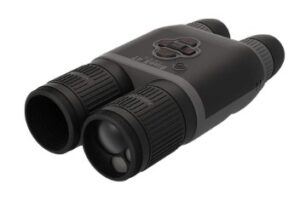 |
ATN BinoX 4T 384 Smart HD Thermal Binoculars | 384×288 sensor, 1.25-5x magnification, built-in LRF, IR illuminator, ballistic information exchange, GPS tagging | Check Price |
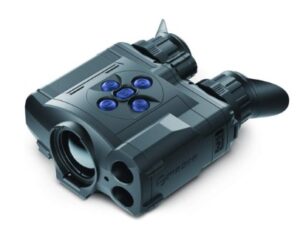 |
Pulsar Accolade 2 LRF XP50 Pro Thermal Binoculars | 640×480 17um sensor, less than 25mK NETD, 2.5-20x magnification, 2,000-yard detection, AMOLED display, IPX7 waterproof | Check Price |
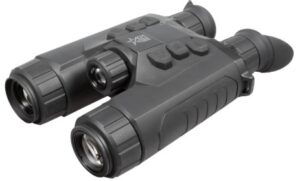 |
AGM Global Vision ObservIR LRF 60-1280 Thermal Binoculars | 1280×1024 display, built-in LRF, image stabilization, 64GB storage, Wi-Fi, picture-in-picture mode, hot-spot tracking | Check Price |
Each of these thermal binoculars brings something distinct to the table, whether that is raw image resolution, an industry-leading battery life, ballistic integration technology, or a combination of features that make them genuinely hard to beat at their price point. Let us dig into each one and figure out exactly what you are getting for your money.
1) ATN BinoX 4T 640 1.5-15x Thermal Binoculars (Best Thermal Binoculars for the Money Overall)
When it comes to packing serious thermal performance into a package that actually makes financial sense, the ATN BinoX 4T 640 is the one I keep coming back to. ATN has been a dominant force in smart optics technology for years, and this binocular represents the company firing on all cylinders.
At its core is a 4th generation 640×480 thermal sensor, and that resolution number matters more than you might think. A 640 sensor has four times the pixel count of a 320-class sensor, which translates directly into a sharper, more detailed image that lets you positively identify a target at distances where lesser sensors would leave you guessing at a fuzzy blob. For hog hunters, predator callers, and anyone else doing serious nighttime fieldwork, that identification capability can be the difference between a clean shot and a wasted round.
The magnification range runs from 1.5x all the way up to 15x, which gives you enormous flexibility. Start at 1.5x to survey a wide field and pick up movement across a big pasture, then dial in to 15x to confirm exactly what you are looking at before you decide to shoot or pass. This is the kind of versatility that used to require carrying two separate optical devices, and having it all in one package is a genuine tactical and practical advantage.
Detection range reaches out to 1,000 yards, and target identification is reliable out to 300 yards — figures that align well with realistic nighttime hunting distances in most parts of North America.
The feature list on the BinoX 4T 640 reads like a wish list that someone actually fulfilled. There is a built-in laser rangefinder, video recording at 1280×960 resolution, image and video storage, and a built-in IR illuminator that helps your hunting partners who are running night vision devices stay oriented to your target.
The ATN Obsidian 4 dual-core processor runs the show and handles all of that processing load without slowing the image down. Wi-Fi connectivity lets you stream live footage to your smartphone and access the full ATN app ecosystem, including the ability to tag animal locations on a map for tracking and monitoring throughout the night.
What genuinely sets this binocular apart from the competition, though, is the battery life. Sixteen hours of continuous use on a single charge is a figure that sounds almost too good to be true in this product category, but ATN backs it up with a proprietary power management system.
Most thermal binoculars in this class top out at six to eight hours, which means a full night hunt can push the limits. With the BinoX 4T 640, you will run out of darkness before you run out of battery.
At 2.5 pounds it is not the lightest option on this list, but for everything it delivers, that is a trade-off most serious hunters will accept without much debate.
Key Features
| Feature | Specification |
|---|---|
| Thermal Sensor | 4th Gen 640×480 |
| Magnification | 1.5-15x |
| Detection Range | 1,000 yards |
| Identification Range | 300 yards |
| Video Recording | 1280×960 |
| Battery Life | 16+ hours |
| Built-in Features | LRF, IR illuminator, Wi-Fi, GPS, video recording |
| Weight | 2.5 lbs |
Pros
- The 16-plus hour battery life is genuinely unmatched in this class and eliminates the anxiety of running out of power during a full-night hunt
- A 4th generation 640×480 sensor delivers sharp, high-detail imagery that makes positive target identification reliable out to 300 yards
- The 1.5-15x magnification range gives you the flexibility to survey wide areas and then zoom in for close target confirmation without swapping equipment
- The built-in video recording, Wi-Fi streaming, LRF, IR illuminator, and GPS make this a true all-in-one system that eliminates the need for multiple carry-along devices
Cons
- At 2.5 pounds it is heavier than most of its competitors, which can become noticeable during extended glassing sessions where you are holding it up for long stretches
If you are ready to bring your nighttime hunting and observation capability to a completely different level, this is the thermal binocular that delivers the full package without forcing you to compromise on the features that matter most. Check it out and see why it consistently tops best-of lists among serious thermal optics users.
2) Pulsar Merger LRF XP50 Thermal Binoculars (Best Premium Thermal Binoculars for the Money)
Pulsar has earned a reputation in the thermal optics world that very few brands can match, and the Merger LRF XP50 is a big reason why. This is a binocular that was built for people who refuse to compromise on image quality, who spend serious time in the field, and who understand that in thermal optics, the sensor is everything.
Pulsar equipped the Merger with a high-end 640×480 resolution thermal sensor paired with an AMOLED display, and the combination produces an image that is genuinely stunning by thermal imaging standards. Colors are vivid, contrast is sharp, and even subtle temperature differences between a target and its background are rendered in a way that makes identification confident and fast.
The magnification range on the Merger runs from 2.5x to 20x via 8x digital zoom, and the detection range stretches out to an impressive 2,000 yards. That is over a mile of effective detection capability, which is a figure that puts this binocular firmly in the category of professional-grade surveillance and long-range hunting tools.
When you are running predator calls in open country or scanning a large feed field for hogs on a property you manage, having that extra range in your corner is not a luxury — it is a genuine operational advantage. At 2.5x you have a wide, immersive field of view for situational awareness, and the digital zoom gives you the ability to close the distance optically when you need a better look at something that caught your eye.
One of the features that gets talked about a lot with the Merger is the Stream Vision 2 app connectivity. Pulsar has developed one of the better companion app ecosystems in the thermal space, and with the Merger you get full Wi-Fi connectivity to stream live footage, download recorded files, share content, and update firmware without needing a computer.
The app also lets a hunting partner or guide watch the same feed you are seeing in real time, which is enormously useful for coordinating a stalk or calling setup with someone positioned elsewhere in the field.
Battery life comes in at a solid 10 hours, which is well above average for a high-end thermal binocular and plenty for an all-night session in most hunting scenarios. The build quality is exactly what you expect from Pulsar’s premium line.
The housing is durable, the controls are intuitive and logically laid out, and the ergonomics make extended glassing sessions comfortable rather than punishing. If you are the kind of hunter or professional who invests in the best tools available because you understand the long-term value of performance and reliability, the Merger LRF XP50 is the thermal binocular that earns that investment every time you take it into the field.
Key Features
| Feature | Specification |
|---|---|
| Thermal Sensor | 640×480 |
| Magnification | 2.5-20x (8x digital zoom) |
| Display | AMOLED |
| Detection Range | 2,000 yards |
| Battery Life | 10 hours |
| Connectivity | Wi-Fi, Stream Vision 2 app (iOS and Android) |
| Built-in Features | Laser rangefinder, video recording |
Pros
- A 2,000-yard detection range is exceptional and gives you genuine long-range capability for open-country hunting and surveillance applications
- The AMOLED display delivers vivid, high-contrast imagery that makes the thermal picture noticeably better than standard LCD-based displays
- A 10-hour battery life is well above the class average and provides confidence for all-night field sessions
- Pulsar’s Stream Vision 2 app ecosystem is one of the best in the business for live streaming, sharing, and firmware management
Cons
- The premium price point puts this binocular above what most entry-level buyers are ready to spend, making it a better fit for experienced users who know exactly what they are getting
There is a reason the Pulsar Merger sits at the top of so many professional recommendation lists. If you are ready for a thermal binocular that delivers truly elite performance night after night, take a serious look at this one — it will not disappoint.
3) ATN BinoX 4T 384 Smart HD Thermal Binoculars (Best Thermal Binoculars for the Money for Hunting)
Nighttime predator and hog hunting has exploded in popularity over the last several years, and a big part of the reason for that is technology like the ATN BinoX 4T 384. This is a hunting-specific thermal binocular that does not just detect heat signatures.
It turns your entire hunting operation into a coordinated, technology-assisted system that keeps you informed, connected, and ready to make the shot. I have seen a lot of thermal binoculars come and go, but the BinoX 4T 384 consistently stands out for the sheer depth of practical, hunt-applicable features it packs into a single device.
The sensor at the heart of the BinoX 4T 384 is a 384×288 thermal detector, which represents the sweet spot between price and performance for most hunting applications. A 384-class sensor gives you a materially sharper and more detailed image than a 320 or 256 sensor, and it does so at a price point that is significantly more accessible than 640-class units.
For most nighttime hog and predator hunting scenarios, which typically play out at distances under 400 yards, a 384 sensor gives you everything you need to confidently identify and target game. The magnification range runs from 1.25x to 5x, keeping the field of view wide enough for fast-action predator calling situations where target acquisition speed matters as much as resolution.
What really makes this binocular stand out from a purely hunting perspective is the ATN BIX (Ballistic Information Exchange) technology. If you are also running an ATN smart scope on your rifle, the BinoX 4T 384 can communicate directly with it.
You range a target with the built-in 1,000-meter laser rangefinder, and that distance data transfers automatically to the scope, which then calculates and displays the correct holdover point for your load and conditions. This is not a gimmick, it is a genuine capability that eliminates manual calculation in the field and reduces the chance of a miss or a poor hit on an animal. Even if you are not running an ATN scope, the built-in rangefinder and ballistic data can be used with the ATN app to calculate holdover for use with a conventional riflescope.
Beyond the ballistic integration, the BinoX 4T 384 includes a built-in IR illuminator that helps hunting partners running night vision devices stay locked on the target you are observing. You can tag animal locations via GPS and have them appear on a map in the ATN app, which is enormously useful for monitoring multiple locations across a large property over the course of a night.
Video recording and live streaming are also on board, so you can document your hunts or let someone at camp watch the action unfold in real time. For the serious nocturnal hunter who wants technology working for them rather than just looking through a passive thermal viewer, the BinoX 4T 384 is an outstanding choice.
Key Features
| Feature | Specification |
|---|---|
| Thermal Sensor | 384×288 |
| Magnification | 1.25-5x |
| Laser Rangefinder | Up to 1,000 meters |
| Built-in Features | Compass, IR illuminator, GPS, BIX ballistic tech, video recording, live streaming |
| Connectivity | Wi-Fi, ATN app (iOS and Android) |
| Special Tech | BIX ballistic information exchange with compatible ATN scopes |
Pros
- The BIX ballistic information exchange system is a genuine game-changer for hunters running ATN scopes, automatically feeding rangefinder data to the scope for precise holdover calculation
- The built-in IR illuminator is a thoughtful feature that lets you actively support hunting partners who are using night vision devices alongside you
- GPS-based animal location tagging inside the ATN app creates a detailed record of animal activity across your property over the course of a hunt
- The wide 1.25-5x magnification range is well matched to close and medium-range predator calling situations where fast target acquisition is critical
Cons
- The depth of smart technology packed into this binocular can feel like it takes some of the traditional sport out of hunting, which may not sit well with hunters who prefer a more traditional approach to the field
If nighttime hunting is a serious part of your season and you want a thermal binocular that works as an active part of your hunting system rather than just a passive observation tool, this is the one to look at closely. Check it out and see how much more effective your next nocturnal hunt could be.
4) Pulsar Accolade 2 LRF XP50 Pro Thermal Binoculars (Best Thermal Binoculars for the Money for Long Range)
There are thermal binoculars, and then there are instruments that make you wonder how you ever managed without them. The Pulsar Accolade 2 LRF XP50 Pro falls firmly into the second category, and it earns that distinction through a combination of truly elite sensor technology, exceptional build quality, and a level of image clarity that has to be seen to be fully appreciated. This is Pulsar’s flagship thermal binocular, and it shows in every detail from the machined controls to the performance figures that put it ahead of virtually everything else in its class.
The sensor in the Accolade 2 Pro is a 640×480 resolution thermal detector with a 17 micrometer pixel pitch and an NETD rating of less than 25 millikelvin. Let me put that in practical terms: NETD is the measure of the smallest temperature difference the sensor can detect. The lower that number is, the more sensitive the sensor, and the better it performs in challenging conditions like rain, fog, or warm ambient temperatures where the contrast between a target and its background is naturally reduced.
A less than 25mK NETD rating puts this sensor in the same tier as instruments used by professional security and military operators. In the field, that means you are picking up heat signatures that would be invisible to lesser sensors, identifying targets at ranges that other binoculars cannot manage, and doing all of it with a crispness and clarity that makes the image genuinely beautiful by thermal standards.
Detection range reaches out to 2,000 yards, which is more than a mile of effective thermal coverage. The native magnification is 2.5x with 8x digital zoom for a maximum of 20x, giving you the ability to start wide and close in on targets without any physical adjustment beyond turning the zoom control.
The integrated laser rangefinder measures distances accurately out to 1,000 meters and operates with a single button press in both single-shot and continuous scanning modes, feeding range data directly into the eyepiece display so you never need to look away from your target to get the information you need.
The AMOLED display renders the thermal image at 640×480 resolution with a 50Hz refresh rate, which means the picture is smooth and lag-free even when you are panning quickly across a scene. Eight color palettes give you options to optimize the display for different ambient temperatures and observation conditions — white hot, black hot, red hot, rainbow, ultramarine, red monochrome, sepia, and violet — and Pulsar’s proprietary Image Boost Technology sharpens the final output beyond what the raw sensor resolution alone would deliver. The unit is IPX7 waterproof rated, meaning it can be submerged in up to one meter of water.
The IPS7 quick-change battery pack delivers up to 7 hours of use and can be swapped in the field without tools, which is a practical and important feature for extended operations. Wi-Fi connectivity and Stream Vision app compatibility round out a package that represents the pinnacle of what thermal binocular technology currently offers.
Key Features
| Feature | Specification |
|---|---|
| Thermal Sensor | 640×480, 17um pixel pitch, less than 25mK NETD |
| Display | 640×480 AMOLED, 50Hz |
| Magnification | 2.5-20x (8x digital zoom) |
| Detection Range | 2,000 yards |
| Laser Rangefinder | Up to 1,000 meters, single and scanning modes |
| Color Palettes | 8 modes including White Hot, Black Hot, Red Hot |
| Waterproofing | IPX7 rated |
| Battery | Quick-change IPS7 Li-Ion, up to 7 hours |
| Connectivity | Wi-Fi, Stream Vision app, 16GB internal storage |
Pros
- The less than 25mK NETD sensor sensitivity is among the best available in any consumer thermal binocular and delivers outstanding performance in low-contrast and challenging weather conditions
- A 2,000-yard detection range combined with up to 20x magnification gives you exceptional long-range observation capability for open country and large property surveillance
- IPX7 waterproof rating provides genuine field confidence in rain, heavy fog, and even accidental submersion
- The quick-change IPS7 battery system lets you swap to a fresh pack in the field without losing any time or fumbling with tools in the dark
Cons
- The premium price reflects the elite sensor and build quality, which puts this binocular at the top of the investment range and makes it a considered purchase that casual or occasional users may find difficult to justify
This is the thermal binocular that professionals reach for when performance is non-negotiable and image quality is the deciding factor. If your standard is the absolute best, check it out and prepare to be seriously impressed with what modern thermal technology is capable of delivering.
5) AGM Global Vision ObservIR LRF 60-1280 Thermal Binoculars (Best Value Thermal Binoculars for the Money)
The AGM Global Vision ObservIR LRF 60-1280 is the binocular that keeps showing up in field tests and expert roundups as the unit that surprises people — and that is the kind of reputation that is hard to fake. AGM has steadily built a name for itself in the thermal optics space by delivering genuine performance at prices that are designed to undercut the more established European and American brands, and the ObservIR is the clearest example of that philosophy paying off in a serious, high-capability product.
When Outdoor Life ran a comprehensive field test of thermal viewers for 2025, the ObservIR walked away with the Best Thermal Binocular designation, and that kind of independent validation means a lot when you are trying to figure out where to put your money.
The standout feature of the ObservIR is its 1280×1024 display resolution, which is significantly higher than what most thermal binoculars in this price tier offer. A higher-resolution display means you are seeing more detail in the thermal image, which makes positive target identification easier and more reliable at distance.
The built-in laser rangefinder extends your targeting information capability without requiring a separate device, and the image stabilization system is genuinely impressive — field testers consistently praised the ObservIR’s stabilized image when panning across landscapes, which is exactly the kind of real-world performance metric that matters during actual use rather than just on a spec sheet.
The ObservIR includes 64 gigabytes of internal image and video storage, which is a generous allocation that lets you document extended observation sessions without worrying about running out of space. Wi-Fi connectivity enables pairing with a mobile app for live streaming and content sharing, and the picture-in-picture mode gives you the ability to see a magnified view of a specific area within the broader thermal image simultaneously — a feature that is enormously useful when you are tracking multiple potential targets across a large area.
Hot-spot tracking automatically highlights the warmest point in the image, which makes picking out animal heat signatures against a warm background much faster and more reliable than doing it manually by eye.
The startup time is quick and the display refresh rate is high, which means the image remains smooth and responsive even during fast target acquisition scenarios. Field testers specifically praised the image quality, noting that the contrast, color rendering, and target detail at distance were among the best they encountered across the entire test lineup.
For a buyer who is entering the thermal binocular market for the first time and wants to get genuine high-end capability without paying the absolute top-tier price, the ObservIR represents one of the smartest buys currently available in the category. It is the kind of thermal binocular that rewards you every single time you put it to your eyes.
Key Features
| Feature | Specification |
|---|---|
| Display Resolution | 1280×1024 |
| Storage | 64GB internal |
| Built-in Features | Laser rangefinder, image stabilization, hot-spot tracking, picture-in-picture mode |
| Connectivity | Wi-Fi, mobile app compatible |
| Special Features | IR illuminator, multiple color palettes |
| Recognition | Best Thermal Binocular, Outdoor Life 2025 Field Test |
Pros
- The 1280×1024 display resolution is among the highest available in this price range and delivers noticeably sharper, more detailed thermal imagery than competing units at similar price points
- Image stabilization makes panning and extended glassing sessions significantly smoother and less fatiguing, a real-world advantage that field testers consistently highlighted
- The 64GB of internal storage is a generous allocation that supports extended documentation sessions without interruption
- Hot-spot tracking and picture-in-picture mode are practical, hunt-ready features that speed up target identification and reduce the chance of missing an animal moving through the scene
Cons
- As a newer brand in the thermal space compared to established names like Pulsar and ATN, AGM does not yet have the same depth of long-term field reliability data, which may give some buyers pause when considering a purchase at this price level
The ObservIR earned its Best Thermal Binocular recognition in a head-to-head field test against some serious competition, and that is not something that happens by accident. If you want exceptional image quality, smart features, and outstanding value in a single thermal binocular package, check this one out — it is a genuinely impressive piece of gear that overdelivers on its price tag.
Conclusion
Thermal binoculars have moved from a military-exclusive technology to one of the most practical and accessible tools a serious hunter or outdoor professional can own, and the five options I covered in this guide represent the best of what is currently available across a range of budgets and use cases.
Whether you are drawn to an industry-leading battery life that outlasts every night in the field, sensor sensitivity that picks up heat signatures in conditions that defeat lesser optics, smart hunting technology that integrates directly with your rifle scope, or a combination of high-resolution display and image stabilization that makes long glassing sessions genuinely comfortable, there is a clear winner in this lineup for your specific needs.
Thermal imaging technology rewards patience and the willingness to invest in quality, and every single binocular on this list will fundamentally change the way you approach the dark. Pick the one that fits your mission and get out there.
See Also: 5 Best Thermal Scopes for Hunting

I’m John V. Howard, a dedicated shooter and hunter who has spent years testing rifles, scopes, and gear in the field. I write from real experience, sharing what truly works, not what’s trendy. My goal is to give you honest, practical insights that help you make the right choices for your adventures and pursuits.