Bestscopesreviews.com is a participant in the Amazon Services LLC Associates Program, an affiliate advertising program designed to provide a means for sites to earn advertising fees by advertising and linking to Amazon.com. Read more.
If you are having a hard time finding the best thermal binoculars for wildlife that genuinely deliver in the field rather than just looking impressive on a spec sheet, I want to save you the hours of research I have already put into this. Wildlife observation is one of the most demanding applications for thermal imaging because you are not just asking the equipment to detect heat.
You are asking it to reveal animal behavior, confirm species identification, and track movement through complex terrain in conditions that range from dense forest to wide open plains in the middle of the night.
The good news is that the thermal binocular market has advanced dramatically, and there are now units that handle all of those demands exceptionally well. In this guide, I will walk you through five outstanding options and cover the features that matter most for wildlife use, what each unit does particularly well, and the one limitation worth knowing before you commit.
By the end you will know exactly which thermal binocular belongs in your field kit.
Best Binoculars Comparison
| Image | Name | Key Features | Check Price |
|---|---|---|---|
 |
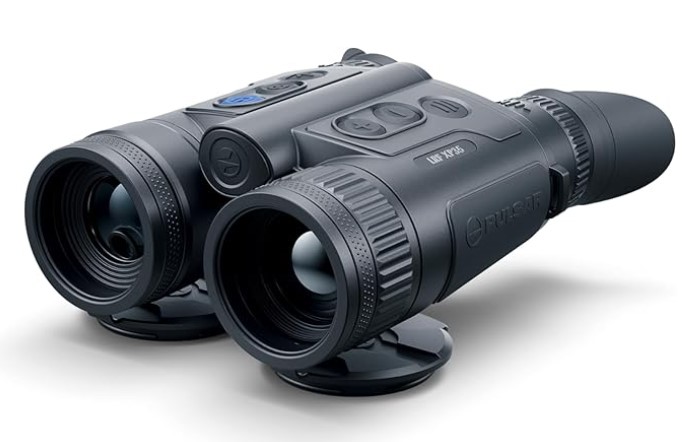
Pulsar Merger LRF XP35 | 640×480 thermal core, 35mm lens, built-in laser rangefinder, 2.5x to 20x magnification, Wi-Fi streaming, IPX7 waterproof | Check Price |
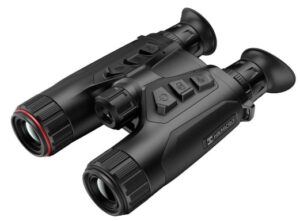 |
Hikmicro Habrok 4K HE25L | 4K optical and thermal fusion display, 25mm thermal lens, 384×288 thermal core, laser rangefinder, switchable display modes | Check Price |
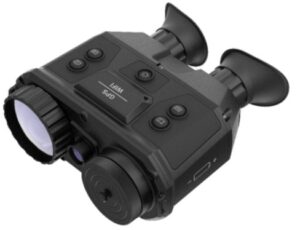 |
AGM Explorator FSB50 640 | 640×512 thermal core, 50mm lens, 2.5x to 20x magnification, multiple color palettes, up to 1800m detection range, IPX7 rated | Check Price |
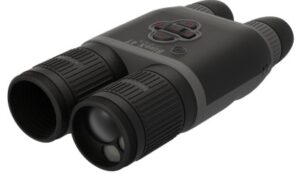 |
ATN BinoX 4T 384 2-8X | 384×288 thermal core, 2x to 8x magnification, built-in laser rangefinder, Obsidian 4 processor, Wi-Fi app streaming, video recording | Check Price |
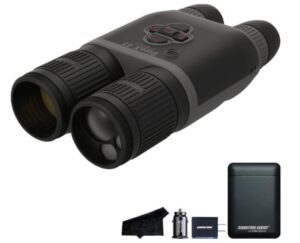 |
ATN BinoX 4T 384 4.5-18X | 384×288 thermal core, 4.5x to 18x magnification, built-in laser rangefinder, ballistic calculator, Obsidian 4 processor, Wi-Fi app streaming | Check Price |
With the comparison table giving you a quick snapshot of the lineup, let us get into the details that actually determine how well each of these units performs in real wildlife observation scenarios. Thermal imaging has genuinely transformed the way naturalists, researchers, wildlife photographers, and outdoor enthusiasts experience the natural world after dark. Animals that are effectively invisible using conventional optics become immediately detectable against their thermal background, revealing behaviors, movement patterns, and ecological interactions that daylight observation simply cannot capture. Here is a full breakdown of each unit and why it earned a place on this list.
1) Pulsar Merger LRF XP35 (Best Thermal Binoculars for Wildlife Observation at Extended Range)
When it comes to thermal binoculars designed for serious wildlife observation, the Pulsar Merger LRF XP35 sets a standard that most of the competition is still working to match. This is a flagship-tier thermal imaging platform that brings together a premium sensor, an intelligent feature set, and a level of build quality that communicates genuine engineering seriousness from the first moment you handle it. For naturalists, wildlife researchers, and dedicated outdoor enthusiasts who want the very best thermal observation experience available at this form factor, the Merger LRF XP35 makes a compelling and largely unanswerable case for itself.
The 640×480 thermal core operating at a 17 micron pixel pitch is the defining specification that separates this unit from the 384 core alternatives in this roundup and across the broader market. Resolution in a thermal imaging sensor works similarly to resolution in a conventional camera: more pixels mean more detail captured across the same field of view, which translates directly into the ability to identify and interpret what you are seeing at greater distances and with greater confidence. When you are observing a wolf pack moving through a meadow at 600 yards, a deer family browsing a forest edge in complete darkness, or a family of bears working a berry slope at dusk, the additional detail that a 640 core provides over a 384 core is not a subtle improvement. It is the difference between watching behavior and merely detecting presence.
The built-in laser rangefinder is a feature that wildlife observers find genuinely useful for reasons that go beyond the obvious distance measurement application. Many serious naturalists and field researchers maintain detailed observation logs that include precise behavioral notes tied to specific locations and distances. Having instantaneous, accurate range data for every observation without carrying a separate rangefinding device simplifies that documentation process considerably. The rangefinder measures up to 1000 meters, which covers the vast majority of practical wildlife observation distances in most terrestrial habitat types.
The 2.5x to 20x magnification range via smooth digital zoom gives you exceptional flexibility across an observation session. Starting a scan of a wetland at 2.5x gives you the wide situational field that lets you detect movement across a broad area efficiently. Zooming into 10x or higher lets you study individual animals in detail, assess body condition, read behavioral cues, and distinguish between individuals in a herd or pack in ways that are simply not possible with a fixed magnification thermal device.
Wi-Fi connectivity allows real-time image streaming to a smartphone or tablet, which is invaluable when observing with a group, conducting organized wildlife surveys, or simply wanting to share a remarkable sighting with a companion without asking them to come look through the eyepiece and risk disturbing the animal. The IPX7 waterproof rating handles the rain, mist, and wet grass of genuine field use without concern, and Pulsar’s reputation for durable construction is backed by years of demanding use in field conditions around the world.
The replaceable battery design is a thoughtful practical detail that matters on long observation sessions: rather than packing up when the charge runs low, you swap a fresh battery pack and continue without interruption.
Key Features
| Feature | Details |
|---|---|
| Thermal Core | 640×480 at 17 micron pixel pitch |
| Lens | 35mm germanium objective |
| Magnification | 2.5x to 20x digital zoom |
| Laser Rangefinder | Built-in, up to 1000m |
| Frame Rate | 50Hz refresh rate |
| Waterproof Rating | IPX7 |
| Connectivity | Wi-Fi streaming to smartphone or tablet |
| Battery | Replaceable rechargeable battery pack |
Pros
- 640×480 thermal core delivers exceptional detail and species identification confidence at extended wildlife observation distances
- Built-in laser rangefinder provides precise distance data that enriches behavioral observation records without additional equipment
- Wide 2.5x to 20x zoom range covers both broad landscape scanning and detailed individual animal study in a single unit
- Wi-Fi streaming enables group wildlife observation and seamless image sharing without disturbing animals
- IPX7 waterproof rating and proven Pulsar build quality handle demanding field conditions across all seasons
Cons
- The premium 640 core and integrated rangefinder carry a correspondingly premium price that places this unit above the accessible range for casual or occasional wildlife observers who would benefit from its capabilities but cannot justify the investment at their frequency of use
The Pulsar Merger LRF XP35 is the thermal binocular that serious wildlife observers reach for when they want to see everything the night has to offer with absolute clarity and confidence. If you are ready to experience wildlife observation at the highest level that personal thermal imaging currently offers, go check it out. What you will see through this unit will genuinely change the way you think about nocturnal wildlife.
2) Hikmicro Habrok 4K HE25L (Best Thermal Binoculars for Wildlife in Dense and Complex Terrain)
Anyone who has spent serious time observing wildlife in forested, brushy, or otherwise complex terrain knows a fundamental truth about pure thermal imaging: it is extraordinarily powerful in open environments and genuinely challenging in dense vegetation. Thermal energy does not pass through leaves, branches, and undergrowth any better than visible light does, and a thermally rich environment full of sun-warmed foliage, decaying organic material, and variable ground cover can produce a cluttered, difficult-to-read image that makes target identification much harder than it is in open country. The Hikmicro Habrok 4K HE25L was built to solve that problem with one of the most sophisticated approaches in the consumer thermal market: true sensor fusion that combines a 4K optical camera with a thermal imager into a single, composited real-time view.
The fusion concept is straightforward to understand and genuinely transformative in practice. The Habrok HE25L captures simultaneous images from both its thermal sensor and its 4K optical camera, then composites them into a single display that shows both the heat signature information from the thermal channel and the structural environmental detail from the optical channel at the same time. What this means for wildlife observation in complex terrain is that you get the animal’s heat signature precisely located within an image that also shows you the branches, trunks, and undergrowth surrounding it. You can see the animal, identify it with confidence, and understand its relationship to the surrounding environment in a single glance rather than trying to mentally construct a complete picture from a thermal-only view that omits all structural context.
The 4K optical camera resolution is the highest available in a consumer fusion thermal binocular, delivering exceptional visual image quality in the optical channel that makes the fused composite image sharp and detailed rather than a blurry overlay. During periods of twilight, moonlight, or any condition where ambient light contributes meaningful information, the optical channel pulls significant weight in making the fused image both useful and beautiful to observe through.
The ability to switch between pure thermal, pure optical, and fused composite modes gives you full flexibility to match your display preference to the conditions you are working in at any given moment. In open country at night with no ambient light, pure thermal may be your preferred mode. In forest at dawn with good light filtering through the canopy, the optical channel alone may tell you everything you need. In the complex mixed scenarios that characterize most real wildlife observation sessions, the fusion mode earns its place every time you use it.
The built-in laser rangefinder provides the distance data that serious wildlife observers need for accurate behavioral documentation and habitat use assessment, and the onboard recording capability lets you capture video of behavioral sequences for later review and sharing. Hikmicro has invested significantly in their app ecosystem, and the Habrok integrates cleanly with their mobile platform for remote viewing and session management.
The 384×288 thermal core at a refined 12 micron pixel pitch delivers thermal image quality that competes credibly with some larger-pixel-pitch 640 core sensors, making the Habrok’s thermal channel a genuine performer rather than a secondary consideration behind the optical fusion feature.
Key Features
| Feature | Details |
|---|---|
| Thermal Core | 384×288 at 12 micron pixel pitch |
| Optical Camera | 4K resolution visible light camera |
| Thermal Lens | 25mm germanium |
| Display Modes | Pure thermal, pure optical, and fused composite |
| Laser Rangefinder | Built-in |
| Video Recording | Onboard recording capability |
| Connectivity | Wi-Fi app compatible |
| Color Palettes | Multiple selectable palettes |
Pros
- 4K optical and thermal fusion provides the most contextually rich and naturally interpretable wildlife observation image available in this unit class
- Fusion mode transforms observation in dense and complex terrain where pure thermal images become difficult to interpret
- Switchable display modes give complete flexibility across changing conditions throughout an observation session
- 12 micron pixel pitch 384 core delivers thermal image quality that competes above its sensor size class
- Onboard video recording preserves behavioral observation sequences for documentation and later study
Cons
- The 25mm thermal objective lens produces a narrower detection range than 50mm alternatives, which limits the unit’s effectiveness for long-range wildlife scanning in wide open habitats where animals may first appear at several hundred meters
The Hikmicro Habrok 4K HE25L is the thermal binocular that makes dense-terrain wildlife observation genuinely rewarding rather than frustratingly ambiguous. If woodland, forest edge, or brushy riparian habitat is where you do most of your wildlife watching, this unit’s fusion capability will transform every session. Go check it out and see what a fully composited thermal and optical view of the natural world looks like.
3) AGM Explorator FSB50 640 (Best Thermal Binoculars for Wildlife Across Large Open Landscapes)
Open landscape wildlife observation operates under a fundamentally different set of optical demands than forest or brushy terrain watching. When you are scanning grassland plains for wolf packs, glassing alpine meadows for elk and bears, surveying coastal marshes for wading birds and mammals at first and last light, or monitoring large agricultural fields for deer and other species, the premium is on detection range, image clarity at distance, and the ability to hold enough thermal detail at extended observation distances to make confident species and individual identifications. The AGM Explorator FSB50 640 is built precisely for that kind of large-landscape thermal observation, and its combination of a 640 resolution core with a 50mm germanium objective lens gives it a capability edge in this specific application that is difficult to match at any price point.
The physics behind why a 50mm lens paired with a 640 core is so effective for long-range wildlife observation are worth understanding briefly because they inform exactly what makes this unit exceptional in open terrain. A larger objective lens gathers proportionally more thermal energy from distant objects, which means that the faint heat differential of an animal at 600 or 800 meters produces a more definite, brighter thermal signal at the sensor plane. The 640 core then captures that signal with twice the linear pixel count of a 384 core, preserving body shape, limb definition, and behavioral cues in the final image that would be reduced to an amorphous warm shape through a lower resolution sensor at the same distance. The combination is not simply additive; it is genuinely multiplicative in its effect on practical observation range and identification capability.
The detection range specification of up to 1800 meters on human-sized targets translates into a practical wildlife observation range on larger animals like elk, moose, and large predators that extends well beyond what any 384 core or any 640 core with a smaller lens can match. For wildlife observers who routinely work landscapes measured in square miles rather than square yards, this range capability is not a luxury. It is a fundamental requirement that determines how much of the available habitat can be meaningfully surveyed in a given session.
The magnification range from 2.5x to 20x via smooth continuous digital zoom gives you the same wide-field-to-detailed-assessment flexibility that makes variable magnification so valuable for wildlife observation. Starting at 2.5x to scan an entire hillside or wetland basin for any movement, then stepping up through the zoom range to study a specific animal or group in detail, is a workflow that experienced wildlife observers execute dozens of times in a single session. Having that range available in a single unit without any optical switching or physical adjustment is a meaningful operational convenience.
Multiple selectable color palettes allow you to optimize the display for the specific conditions of each observation session. White hot rendering is preferred by many observers for general wildlife use as it produces the most intuitive body-shape rendering. Black hot can improve contrast in specific lighting conditions. The ability to switch between palettes in the field rather than being locked into a single rendering mode is a genuine quality-of-life improvement during extended observation sessions where conditions evolve throughout the night.
The IPX7 waterproof rating means dew, rain, and stream crossings are non-events, and the rugged chassis construction is built for the kind of regular field use that serious wildlife observation demands.
Key Features
| Feature | Details |
|---|---|
| Thermal Core | 640×512 |
| Lens | 50mm germanium objective |
| Magnification | 2.5x to 20x digital zoom |
| Detection Range | Up to 1800m on human-sized targets |
| Color Palettes | Multiple including white hot, black hot, red hot |
| Frame Rate | 50Hz refresh rate |
| Waterproof Rating | IPX7 |
| Battery | Built-in rechargeable with USB-C charging |
Pros
- 640×512 core with 50mm lens delivers the highest practical detection and identification range on this list for open landscape wildlife observation
- Outstanding image detail at extended distances allows confident species identification and behavioral assessment where other units lose resolution
- Full 2.5x to 20x zoom range covers both wide landscape scanning and detailed individual study in a single continuous adjustment
- Multiple color palette options allow display optimization for changing conditions across an observation session
- IPX7 waterproof rating and robust construction handle demanding all-weather field use reliably
Cons
- The 50mm objective lens and 640 core combination results in a physically larger and heavier unit than alternatives with smaller lenses, which is worth weighing if your wildlife observation involves significant foot travel or requires sustained handheld use over long observation periods
The AGM Explorator FSB50 640 is the thermal binocular for wildlife observers who work big landscapes and refuse to miss an animal because their optics ran out of range before the terrain did. If open country observation across meadows, plains, marshes, or alpine terrain is your primary focus, go check this unit out. It will show you animals you simply would not have detected with anything smaller.
4) ATN BinoX 4T 384 2-8X (Best Thermal Binoculars for Wildlife Observers Who Want Smart Connected Features)
ATN has built a strong following in the thermal optics community by doing something that the European and Asian premium brands have been slower to prioritize: packing genuinely useful smart technology into their devices at price points that make the capability accessible to a much wider audience of outdoor enthusiasts. The BinoX 4T 384 in the 2-8x configuration is a clear expression of that philosophy, delivering a connected, intelligent thermal binocular experience that goes significantly beyond simple thermal viewing and brings capabilities to the wildlife observer that a decade ago would have required multiple separate devices and a significant professional budget.
The 384×288 thermal core is the foundation of the BinoX 4T’s observational capability, and in ATN’s implementation with the Obsidian 4 processor it delivers performance that is entirely appropriate for the primary use cases of wildlife observation at close to moderate distances. Mammals, birds, and reptiles at distances up to 400 meters register clearly against their thermal backgrounds, producing the kind of images that allow confident species identification, behavioral observation, and population counting that are the practical goals of most nocturnal wildlife observation sessions. The 2x to 8x magnification range is well matched to those distances, providing a comfortable wide field at 2x for scanning stream corridors, forest openings, and field margins, and enough magnification at 8x to study individual animals in meaningful detail.
The Obsidian 4 processor is where the BinoX 4T genuinely distinguishes itself from simpler thermal binoculars at this price level. The processing platform handles the image quality and smoothness of the thermal display while simultaneously running the suite of smart features that make this unit so interesting for wildlife observers. The built-in laser rangefinder provides instant distance data that is immediately useful for behavioral documentation and habitat use studies. The onboard video recording captures behavioral sequences in thermal video format that can be reviewed, shared, and used as documentation in ways that still photographs from a separate camera cannot replicate for nocturnal observations.
The iOS and Android app connectivity is arguably the feature that most meaningfully separates the BinoX 4T experience from conventional thermal binoculars for group wildlife observation. Being able to stream what you are seeing through the binoculars to a companion’s tablet in real time means that two people can observe and discuss the same animal simultaneously without both needing to handle the unit or take turns at the eyepiece. For wildlife educators, guided wildlife experiences, and organized observation groups, this streaming capability is a tool that genuinely enhances the shared observation experience in ways that are difficult to replicate any other way.
Many mammals that are the primary targets of nocturnal wildlife observation, including foxes, badgers, otters, deer, and various bat species, are active in the hours immediately after dark and before first light precisely because they have learned to associate daylight with human activity and risk. Thermal imaging that requires no light source, produces no sound, and can be operated from a comfortable distance without disturbing target animals is the closest thing to genuinely non-intrusive nocturnal observation that personal optics technology currently offers, and the BinoX 4T delivers that experience at a price point that makes it accessible to serious amateur naturalists and wildlife enthusiasts rather than just professional researchers.
Key Features
| Feature | Details |
|---|---|
| Thermal Core | 384×288 |
| Magnification | 2x to 8x |
| Processor | ATN Obsidian 4 |
| Rangefinder | Built-in laser rangefinder |
| Video Recording | Onboard thermal video recording |
| Connectivity | iOS and Android app via Wi-Fi streaming |
| Ballistic Calculator | Integrated with rangefinder data |
| Battery | Built-in rechargeable, USB-C charging |
Pros
- ATN Obsidian 4 processor delivers smart connected features including rangefinder, recording, and app streaming at an accessible price point
- Real-time Wi-Fi streaming to smartphones and tablets enables shared group wildlife observation without passing the unit between observers
- Onboard thermal video recording captures nocturnal behavioral sequences for documentation, study, and sharing
- 2x to 8x magnification is ideally matched to close to moderate distance wildlife observation in woodland, riparian, and mixed cover habitats
- Excellent value for a feature-rich connected thermal binocular backed by ATN’s established platform ecosystem
Cons
- The 384 core and 8x maximum magnification establish a practical ceiling on long-range observation performance that makes this unit less well suited to wide open landscapes where wildlife may need to be assessed at distances beyond 400 to 500 meters
The ATN BinoX 4T 384 2-8X brings a connected, intelligent thermal observation experience to wildlife enthusiasts who want more than just a thermal image to look at and a genuinely useful ecosystem of features to work with in the field. If you observe wildlife in close to moderate range habitats and want the ability to stream, record, and share what you are seeing, go check this unit out. It delivers a lot more than its price tag suggests.
5) ATN BinoX 4T 384 4.5-18X (Best Thermal Binoculars for Wildlife at Extended Observation Distances)
The two ATN BinoX 4T 384 variants on this list share everything except the magnification range, and that single difference redirects the 4.5-18x version toward a distinct set of wildlife observation scenarios where the added reach of the higher zoom range pays meaningful dividends. If the 2-8x model is optimized for close and moderate-range observation in complex terrain and mixed cover habitats, the 4.5-18x is the configuration for wildlife observers who regularly need to assess animals at distances where 8x magnification begins to feel limiting and who work landscapes where greater zoom range opens up meaningful additional observational territory.
The 4.5x to 18x range represents a genuinely useful expansion of the platform’s observational envelope for wildlife use. At 4.5x you still have enough field of view to scan a meadow clearing or lake margin effectively for any warm signatures. Stepping through the mid-range zoom levels from 8x to 12x puts you in the productive assessment zone where a 384 core can resolve enough body detail on a mammal-sized target at several hundred meters to confirm species identity and read behavioral posture with confidence. Pushing to 18x at the top of the range gives you the reach to study distant individuals, assess body condition, check for distinctive markings or tags in monitored populations, and observe behavioral interactions that would require much closer approach to assess through a lower-magnification instrument.
This higher magnification ceiling is particularly valuable for wildlife observers working habitats where close approach is either impractical or undesirable from a non-disturbance perspective. Raptor and owl roost monitoring, large mammal behavioral studies, waterfowl and wading bird observation on wide wetlands, and monitoring of sensitive species that show flight responses at close approach distances are all applications where the ability to stay further back while maintaining meaningful observational resolution is a direct benefit to both the observer’s data quality and the welfare of the animals being observed.
The complete Obsidian 4 feature set carries over unchanged from the 2-8x variant: the built-in laser rangefinder, the onboard thermal video recording, the iOS and Android app connectivity with real-time Wi-Fi streaming, and the ballistic calculator that while more relevant in a hunting context also provides useful data for distance-calibrated behavioral documentation in a research or naturalist context. All of these features work identically in the 4.5-18x unit and add the same practical value to wildlife observation sessions regardless of which variant you choose.
The observation notes of early naturalists like John Muir and Aldo Leopold are full of observations made at dawn and dusk when wildlife is most active, with authors frequently noting the challenge of seeing clearly enough in poor light to accurately describe what they were observing. It is a compelling thought experiment to consider what those observers might have documented with access to a thermal binocular that requires no light at all to produce a clear, detailed image of an animal at several hundred meters in complete darkness. The 4.5-18x BinoX 4T makes that kind of observation accessible to anyone willing to spend a night in good wildlife habitat with an open eye and a curious mind.
The USB-C charging and reasonable cold-weather battery performance make extended overnight observation sessions viable without significant power management overhead, and the unit is sized and weighted appropriately for handheld use during active observation sessions in the field.
Key Features
| Feature | Details |
|---|---|
| Thermal Core | 384×288 |
| Magnification | 4.5x to 18x |
| Processor | ATN Obsidian 4 |
| Rangefinder | Built-in laser rangefinder |
| Video Recording | Onboard thermal video recording |
| Connectivity | iOS and Android app via Wi-Fi streaming |
| Ballistic Calculator | Integrated with rangefinder data |
| Battery | Built-in rechargeable, USB-C charging |
Pros
- 4.5x to 18x magnification range extends the platform’s practical observational reach significantly beyond what the 2-8x variant can cover at distance
- Higher magnification ceiling enables non-disturbance observation of sensitive species and flight-responsive animals from respectful distances
- Full Obsidian 4 smart feature set including rangefinder, thermal video recording, and app streaming carries over completely
- Useful for population monitoring, behavioral research, and any application requiring assessment of specific individuals at extended range
- Strong value for connected extended-range thermal observation capability without reaching into premium-tier pricing
Cons
- The 4.5x minimum magnification produces a narrower minimum field of view compared to the 2x entry point of the companion variant, which makes close-range wide-field scanning slightly less comfortable in dense cover where broad situational awareness at low magnification is the priority
The ATN BinoX 4T 384 4.5-18X gives wildlife observers the extended reach to see more of what the night is doing without disturbing the animals they came to watch, and that respectful observational distance is one of the most important things any wildlife optic can enable. Go check it out and see what patient observation at extended range reveals about the nocturnal wildlife sharing your landscape.
Conclusion
What I find most remarkable about reviewing this collection of thermal binoculars is how clearly each one has been shaped by a genuine understanding of what wildlife observers actually need in the field. This is not a category of optics that was designed in a conference room by people who have never spent a night watching a fen for otters or glassing a hillside for bears.
The units on this list reflect real field experience translated into engineering decisions, and that authenticity shows up in features like fusion imaging for complex terrain, swappable batteries for overnight sessions, streaming connectivity for group observation, and the kind of rugged weatherproofing that a genuinely-used field instrument demands.
Thermal imaging has changed wildlife observation more fundamentally than any other technological development since the introduction of quality optical glass. It has revealed a nocturnal world that was effectively hidden from human view for our entire history as observers of nature, and it has done so in a completely non-intrusive way that imposes no stress on the animals being observed.
That combination of revelation and respect is the most compelling argument for thermal binoculars as a wildlife observation tool, and every unit on this list delivers that experience with a level of quality that would have seemed extraordinary just a few years ago.
Pick the unit that matches your terrain, your observation distances, and your budget. Get outside after dark. The wildlife is out there, and now you have the tools to find it.
See Also: 5 Best Monoculars for Bird Watching

I’m John V. Howard, a dedicated shooter and hunter who has spent years testing rifles, scopes, and gear in the field. I write from real experience, sharing what truly works, not what’s trendy. My goal is to give you honest, practical insights that help you make the right choices for your adventures and pursuits.