Bestscopesreviews.com is a participant in the Amazon Services LLC Associates Program, an affiliate advertising program designed to provide a means for sites to earn advertising fees by advertising and linking to Amazon.com. Read more.
Do you want to buy the best telescopes for beginners but have no idea where to start or which ones are actually worth your money? I completely understand that feeling. Walking into the world of amateur astronomy for the first time is exciting, but the sheer volume of options, specs, and opinions online can make the whole process feel more overwhelming than it should.
The last thing you want is to spend good money on a scope that ends up gathering dust because it was too complicated, too flimsy, or simply the wrong tool for a new observer.
Here is the good news: finding a genuinely great beginner telescope is entirely possible, and I have done the research to make your decision much easier. In this guide, I am going to walk you through five outstanding options that hit the right balance of quality, usability, and value for first-time observers.
I will cover the key features of each scope, what makes it a smart pick for beginners, and the one thing you should know before buying. By the end, you will have everything you need to make a confident first purchase.
Best Scopes Comparison
| Image | Name | Key Features | Check Price |
|---|---|---|---|
 |
Celestron NexStar 5SE Computerized Telescope | 5 inch Schmidt Cassegrain, single arm GoTo mount, 40,000 object database, SkyAlign automated alignment, 1250mm focal length | Check Price |
 |
Sky Watcher Classic Dobsonian Telescope 8 Inch | 8 inch parabolic mirror, manual alt-azimuth Dobsonian mount, 1200mm focal length, 2 inch focuser, two eyepieces included | Check Price |
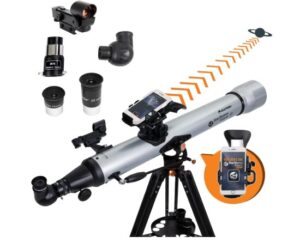 |
Celestron StarSense Explorer LT 80AZ Refractor Telescope | 80mm refractor, StarSense Explorer smartphone app dock, alt-azimuth mount, 900mm focal length, fully coated optics | Check Price |
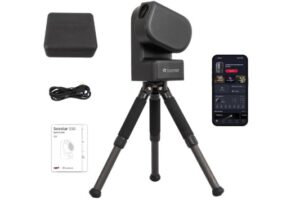 |
ZWO Seestar S50 All-in-One Smart Telescope | 50mm refractor, integrated Sony IMX462 sensor, built-in motorized filter wheel, autonomous app controlled imaging, dual band filter included | Check Price |
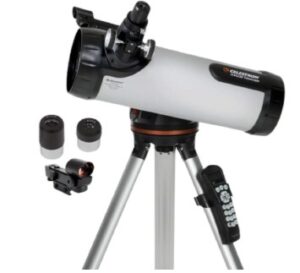 |
Celestron 114LCM Computerized Telescope | 114mm Newtonian reflector, single arm computerized GoTo mount, SkyAlign alignment, 1000mm focal length, 4,000 object database | Check Price |
Now that you have a quick overview of all five telescopes, let us get into what really matters. Each of these scopes has been chosen because it excels in a specific way that genuinely benefits a beginner, and understanding those strengths will help you zero in on the right pick for your situation. Whether you are after automated GoTo technology, raw aperture, smartphone guidance, or a fully automated smart imaging system, the right scope for you is somewhere on this list.
1) Celestron NexStar 5SE Computerized Telescope (Best Telescope for Beginners Who Want Automated Star Finding)
One of the biggest frustrations new observers run into is not being able to find anything in the night sky. You know the objects are up there. You read about them. You looked them up online. But when you point a manual telescope at the sky and try to locate Saturn or a distant galaxy for the first time, the experience can feel humbling in a way that discourages people from continuing. The Celestron NexStar 5SE was designed specifically to eliminate that frustration, and it does it better than almost any other entry-level computerized scope on the market.
At the heart of the 5SE is a 5 inch Schmidt Cassegrain optical tube. Schmidt Cassegrain telescopes use a folded optical path that delivers a long focal length in a compact body, giving you 1250mm of reach in a tube small enough to carry comfortably in one hand. This design is exceptionally versatile for a beginner because it handles a wide range of targets well: crisp views of the Moon and planets, satisfying views of globular clusters and double stars, and decent peeks at brighter deep sky objects like the Orion Nebula and the Andromeda Galaxy.
The single arm GoTo computerized mount is the feature that makes the 5SE transformative for first-time observers. You power it on, point it at three bright objects using the simple SkyAlign procedure, and from that point the mount knows exactly where everything in the sky is located. You scroll through the 40,000 object database, select what you want to see, press Go To, and the telescope moves automatically to place that object in your eyepiece. For a beginner this is genuinely game-changing because it means your very first night out can be filled with successful views rather than confusion and searching.
The SkyAlign alignment process is one of Celestron’s genuinely user-friendly contributions to the hobby. You simply center any three bright objects you can see in the eyepiece, and the mount figures out the alignment from there. You do not need to identify specific stars, you do not need a star atlas, and you do not need prior astronomy knowledge. If you can see three bright lights in the sky, you can align this telescope and be finding objects within five minutes of setup.
The build quality is solid for this price range, with a sturdy tripod, smooth mount movements, and optical coatings that produce clean, high contrast images across a range of magnifications. The included 25mm eyepiece provides a comfortable starting magnification that shows plenty of sky while still delivering clear views of brighter targets.
The quick release optical tube means the entire telescope breaks down and sets back up in minutes, which encourages regular use. And regular use is exactly what transforms a curious beginner into a confident, passionate observer.
Key Features
| Feature | Details |
|---|---|
| Aperture | 5 inches (127mm) |
| Optical Design | Schmidt Cassegrain |
| Focal Length | 1250mm |
| Focal Ratio | f/10 |
| Mount Type | Single arm computerized alt-azimuth GoTo |
| Alignment System | SkyAlign automated three star |
| Object Database | 40,000 plus celestial objects |
| Included Eyepiece | 25mm (50x magnification) |
Pros
- GoTo mount with 40,000 object database automatically finds and tracks any target, eliminating the biggest beginner frustration
- SkyAlign procedure gets you aligned and observing in under five minutes with no prior star knowledge required
- Compact Schmidt Cassegrain tube is easy to carry and sets up in minutes
- 5 inch aperture delivers satisfying views of planets, Moon, clusters, and brighter deep sky objects
- Quick release tube and single arm design make the whole telescope fast to break down and store
Cons
- The single arm alt-azimuth mount is not well suited to long exposure astrophotography without an additional equatorial wedge, so dedicated imagers will eventually want to upgrade their mount
The Celestron NexStar 5SE is one of the most rewarding first telescopes you can buy, and I genuinely believe it has introduced more people to the joy of astronomy than almost any other scope in its class. If you want a computerized telescope that just works from night one, go check it out and see what your skies have been hiding from you.
2) Sky Watcher Classic Dobsonian Telescope 8 Inch (Best Telescope for Beginners Who Want Maximum Views for the Money)
There is a saying in the astronomy community that aperture is everything, and while experienced observers know there is more nuance to it than that, the underlying truth holds up remarkably well. More aperture means more light collected, and more light means brighter, more detailed views of everything in the night sky. The Sky Watcher Classic 8 Inch Dobsonian takes that principle and delivers it at a price that makes it one of the most recommended first telescopes among experienced observers who know what they are talking about. If your goal is to see as much of the universe as possible right from the start, this is the telescope to buy.
An 8 inch parabolic mirror is a serious amount of light gathering power. At this aperture you are collecting approximately 1,300 times more light than the naked eye. In practical terms that means the Orion Nebula goes from a faint smudge to a glowing cloud with visible structure. Globular clusters resolve from fuzzy blobs into swarms of individual stars. Galaxies that you cannot see at all without a telescope start showing hints of shape and form. The jump from smaller entry-level scopes to an 8 inch Dobsonian is genuinely dramatic in a way that surprises first-time observers every single time.
The Dobsonian mount design is one of the simplest and most elegant solutions in all of amateur astronomy. Named after the late amateur astronomer John Dobson who popularized it as a way of putting large apertures in the hands of ordinary people, the Dobsonian rocker box and altitude bearings allow you to swing the telescope smoothly in any direction with just two fingers. There are no motors, no batteries, no alignment procedures, and no setup complexity. You carry the base outside, set the tube in it, find a bright star in the finder scope, and you are observing. It takes about two minutes from the moment you step outside.
For beginners this simplicity is a genuine advantage. Every session starts immediately without fumbling with technology, and navigating the sky manually with a Dobsonian teaches you real observational skills that make you a more capable astronomer over time. Learning to star hop from a bright star to a nearby target using a finder scope and paper atlas is deeply satisfying in a way that automated GoTo systems cannot replicate, and many experienced observers who started on Dobsonians credit that early manual navigation with their deep understanding of the night sky.
The 1200mm focal length at f/6 gives a balanced field of view across a range of eyepieces, performing well for both wide field sweeping at low magnification and detailed planetary views at higher powers. The included eyepieces get you started immediately, and the 2 inch focuser opens up a world of wide angle eyepiece options as your collection grows.
The Sky Watcher Classic Dobsonian is also sturdily built, with a rocker box and altitude bearings that feel stable and smooth rather than cheap and wobbly. This is a telescope you can realistically own for decades and continue to enjoy at every level of the hobby.
Key Features
| Feature | Details |
|---|---|
| Aperture | 8 inches (203mm) |
| Optical Design | Parabolic Newtonian reflector |
| Focal Length | 1200mm |
| Focal Ratio | f/5.9 |
| Mount Type | Manual alt-azimuth Dobsonian rocker box |
| Focuser | 2 inch rack and pinion |
| Included Eyepieces | 25mm and 10mm |
| Finder Scope | 8×50 included |
Pros
- 8 inch aperture delivers spectacular deep sky views that dramatically outperform smaller beginner telescopes
- Dobsonian mount is the simplest possible design with zero setup complexity and no batteries required
- Manual navigation builds real observational skills and deepens your understanding of the night sky
- Exceptional value for the aperture compared to any other telescope design at this price point
- Sturdy long-lasting build quality that holds up through years and decades of regular use
Cons
- The manual mount requires you to nudge the telescope every few minutes as Earth’s rotation moves objects out of the field of view, which takes some adjustment for new observers used to automated systems
If you want the most telescope your money can buy and you are excited about the idea of actually learning the night sky while you observe, the Sky Watcher Classic 8 Inch Dobsonian is one of the smartest first telescope purchases you can make. Go check it out and see just how much universe is waiting for you to discover it.
3) Celestron StarSense Explorer LT 80AZ Refractor Telescope (Best Telescope for Beginners Who Want Smartphone-Guided Star Finding)
Finding your way around the night sky has traditionally been one of the steepest parts of the beginner learning curve. Manual star hopping requires patience and practice, and fully computerized GoTo mounts add significant cost and complexity to an entry-level setup. The Celestron StarSense Explorer LT 80AZ sits in a clever middle ground between those two options, using your smartphone’s camera and processing power to map the sky in real time and guide you to your target without requiring a motorized mount, a hand controller, or a power source. It is one of the most genuinely clever beginner telescope designs to appear in the hobby in recent years.
The StarSense Explorer technology works through a dedicated dock on the telescope that holds your smartphone at a precise angle relative to the optical axis. The free StarSense Explorer app uses your phone’s camera to capture the star field around wherever you are pointing and compares it against an onboard star catalog to determine exactly where the telescope is aimed. The app then displays an arrow and a distance indicator on screen, and you physically move the telescope in the direction the app indicates until your target is centered. The whole process takes seconds once you understand it, and the accuracy is impressive enough that most targets end up within the eyepiece field of view on the first attempt.
The 80mm refractor optical tube is a genuinely solid choice for a beginner instrument. Refractors use a lens rather than a mirror to focus light, which means they require virtually no maintenance, never need collimation, and produce views that are crisp and high contrast right out of the box. An 80mm aperture is large enough to show you the Moon in extraordinary detail, split double stars cleanly, reveal the cloud bands on Jupiter, show Saturn’s rings, and track down bright deep sky showpieces like the Pleiades cluster and the Beehive. It is not going to show you faint galaxies in the same way a larger reflector will, but for a first telescope the range of targets it handles well is genuinely satisfying.
The alt-azimuth mount is simple, smooth, and stable. Without any motors or electronics in the mount itself, there is nothing to go wrong and nothing that requires power. You move the telescope by hand and the StarSense app tells you where to point. This combination of manual simplicity and intelligent smartphone guidance produces an experience that feels intuitive and modern without adding unnecessary complexity or cost.
The 900mm focal length at f/11.25 gives good magnification for planetary targets, and the included eyepieces provide a sensible starting range for new observers. The compact refractor tube means the entire setup is lightweight and easy to carry outside for spontaneous observing sessions, which matters enormously when it comes to how often you actually use your telescope.
Celestron’s build quality is reliable at this price point, and the StarSense Explorer app receives regular updates that improve its performance and expand its target catalog over time. Buying into this ecosystem means your telescope gets smarter as the software improves.
Key Features
| Feature | Details |
|---|---|
| Aperture | 80mm (3.1 inches) |
| Optical Design | Refractor |
| Focal Length | 900mm |
| Focal Ratio | f/11.25 |
| Mount Type | Manual alt-azimuth with StarSense dock |
| Guidance System | StarSense Explorer smartphone app (free) |
| Coatings | Fully coated optics |
| Included Eyepieces | 10mm and 20mm |
Pros
- StarSense Explorer smartphone technology guides you to any target without a motorized mount or complex alignment
- Low maintenance refractor optics deliver sharp, high contrast views and never need collimation
- Lightweight and compact design encourages spontaneous observing sessions
- No batteries required in the mount keeps the setup simple and reliable in the field
- Free app receives regular updates adding new targets and improving pointing accuracy over time
Cons
- The 80mm aperture limits views of faint deep sky objects compared to larger reflector-based beginners telescopes at a similar price, so those primarily interested in galaxies and nebulae may want to consider a larger aperture option
The Celestron StarSense Explorer LT 80AZ is a genuinely smart first telescope that takes the guesswork out of finding objects without going down the expensive computerized mount route. If the idea of using your smartphone to navigate the entire night sky sounds like your kind of experience, go check this scope out and see how quickly it gets you observing with confidence.
4) ZWO Seestar S50 All-in-One Smart Telescope (Best Telescope for Beginners Who Want Stunning Astrophotos from Night One)
Astrophotography has traditionally been one of the most technically demanding areas in all of amateur astronomy, requiring polar alignment, autoguiding, calibration frames, and hours of post-processing software work before you ever produce a finished image. That barrier has kept countless people from ever attempting it, even people who are deeply interested in what a camera pointed at the night sky can capture. The ZWO Seestar S50 was built to dismantle that barrier entirely, and it does so in a form factor that fits in a backpack and operates almost entirely on its own once you point it roughly at the sky.
The Seestar S50 is a 50mm refractor with a Sony IMX462 back-illuminated CMOS sensor built directly into the optical assembly. Back-illuminated sensors are significantly more light-efficient than conventional designs, capturing a higher percentage of the photons that reach the sensor surface rather than losing them in the circuitry layer that older sensors place in front of the light-sensitive area. For a 50mm aperture instrument this efficiency is critical, and it is a meaningful part of why the S50 produces images that consistently surprise people who expect modest results from such a compact telescope.
The built-in motorized filter wheel includes a dual band narrowband filter that passes only the specific wavelengths emitted by ionized hydrogen and oxygen in emission nebulae while blocking the broad spectrum glow of light pollution. This single feature transforms what is possible under suburban and urban skies, allowing a beginner in a brightly lit neighborhood to capture genuinely colorful and detailed images of objects like the Orion Nebula, the Lagoon Nebula, and the Rosette Nebula in ways that would be impossible without that filtration. For urban observers this is not just a convenience, it is a game changer.
The entire workflow is controlled through the Seestar app on your smartphone or tablet via Wi-Fi. You open the app, tap on a target in the catalog, and the telescope slews, focuses automatically using the built-in autofocus motor, aligns to the target, and begins capturing and stacking sub-exposures in real time. You watch the image build up on your device as the telescope works. Faint nebulae and galaxies emerge from the darkness over the course of fifteen to thirty minutes of stacking, and there is a genuinely exciting quality to watching that process unfold without having done anything technically demanding to make it happen.
The self-contained design includes a built-in rechargeable battery, a motorized alt-azimuth GoTo mount, and an extremely compact chassis that weighs under three pounds complete. You can set it up on any flat surface, a balcony railing, a picnic table at a dark sky site, or the roof of your car, and be imaging within a few minutes. For beginners who want results before they have learned a demanding technical skill set, the S50 delivers an experience that simply did not exist at this price point a few years ago.
The 50mm aperture does mean there is a ceiling on resolution and the finest detail achievable, and as a pure visual telescope it is less compelling than larger instruments. But as a beginner imaging platform that produces genuinely impressive results with virtually no learning curve, it occupies a unique and highly valuable position in the market.
Key Features
| Feature | Details |
|---|---|
| Aperture | 50mm |
| Optical Design | Refractor |
| Focal Ratio | f/5 |
| Imaging Sensor | Sony IMX462 back-illuminated CMOS |
| Filter Wheel | Built-in motorized with dual band narrowband filter |
| Control | Smartphone app via Wi-Fi |
| Power | Built-in rechargeable battery |
| Weight | Under 3 lbs complete |
Pros
- Fully automated imaging workflow requires no prior technical knowledge and produces results from session one
- Built-in dual band filter enables impressive deep sky imaging from light-polluted urban and suburban locations
- Sony IMX462 back-illuminated sensor delivers exceptional low-light efficiency in a compact package
- Extremely portable self-contained design with built-in battery works anywhere without external power
- Real time live stacking lets you watch your astrophotos develop on your device as the telescope works
Cons
- The 50mm aperture limits the fine resolution and detail achievable compared to larger instruments, making it less suitable for visual observing and for beginners who intend to grow into high-resolution imaging over time
If seeing your own astrophotos of nebulae and galaxies on your first night out sounds like the experience you are after, the ZWO Seestar S50 makes that happen without asking you to master a technical skill set first. Go check it out and see why it has genuinely changed what beginner astrophotography looks like.
5) Celestron 114LCM Computerized Telescope (Best Telescope for Beginners Who Want GoTo Technology on a Tight Budget)
Budget is one of the most important practical realities in any buying decision, and when it comes to beginner telescopes it shapes the conversation significantly. The Celestron 114LCM is a telescope that takes the convenience of computerized GoTo technology and makes it accessible at a price point where most manufacturers are still selling purely manual instruments. For beginners who want the experience of automated star finding without stretching into higher price territory, the 114LCM offers a compelling entry point into computerized astronomy.
The 114mm Newtonian reflector optical tube is a solid performer for its class. Newtonian reflectors use a parabolic primary mirror to collect and focus light, producing images with the kind of clean contrast and edge-to-edge sharpness that makes them popular across all levels of the hobby. At 114mm aperture you have a meaningful light collecting advantage over smaller refractors, giving you brighter views of deep sky objects, cleaner resolution of double stars, and noticeably more detail on the surfaces of the Moon and planets. The 1000mm focal length at f/8.8 is well balanced for a range of targets and magnifications.
The single arm computerized mount is the headline feature of this telescope. It uses the same intuitive SkyAlign alignment procedure found on Celestron’s more expensive computerized scopes: you center three bright objects in the eyepiece, the mount computes its orientation from those references, and from that point it can find and track any of the 4,000 objects in its onboard database automatically. The database includes all the major showpieces that beginners love to visit: the great planets, famous nebulae, bright star clusters, and the most accessible galaxies. For a first-time observer these 4,000 objects represent far more observing than you will realistically complete in your first year.
The SkyAlign alignment process is notably straightforward. Unlike earlier generation computerized mounts that required you to identify specific named stars by sight before the system would cooperate, SkyAlign works with any three bright objects you can see. Bright stars, planets, and the Moon are all valid targets. This dramatically lowers the barrier for complete beginners who have not yet memorized the major constellations or the positions of bright stars across the sky.
The motorized tracking that keeps objects centered in the eyepiece once you have located them is one of those quality-of-life features that beginners often overlook until they experience its absence. When you are sharing a telescope with friends or family members who all want a look at Saturn, having the mount automatically keep the planet centered means everyone gets a great view rather than spending half the session re-finding the target every time someone different steps up to the eyepiece.
The 114LCM is not going to compete with larger instruments for raw optical performance, and the mount is not suited to serious astrophotography. But as an affordable introduction to computerized astronomy that makes the sky accessible and observing sessions enjoyable from the very first night, it does its job genuinely well.
Key Features
| Feature | Details |
|---|---|
| Aperture | 114mm (4.5 inches) |
| Optical Design | Newtonian reflector |
| Focal Length | 1000mm |
| Focal Ratio | f/8.8 |
| Mount Type | Single arm computerized alt-azimuth GoTo |
| Alignment System | SkyAlign automated three object |
| Object Database | 4,000 celestial objects |
| Included Eyepieces | 25mm and 9mm |
Pros
- Computerized GoTo technology at one of the most accessible price points in the beginner telescope market
- SkyAlign alignment works with any three bright objects, requiring no prior star identification knowledge
- Motorized tracking keeps targets centered automatically for a better shared viewing experience
- 114mm Newtonian optics deliver meaningful aperture advantage over smaller entry-level refractors
- 4,000 object database covers every major showpiece target a beginner will want to visit in their first year
Cons
- The smaller 4,000 object database and entry-level mount construction mean this telescope has a more limited ceiling than the other computerized options on this list, and enthusiastic observers may find themselves wanting a more capable system sooner than expected
The Celestron 114LCM proves that you do not have to spend a fortune to enjoy the genuine convenience of a GoTo computerized telescope. If you want to point at objects automatically and actually find them on your first night out without breaking the bank, go check this scope out and see what you have been missing.
Conclusion
What I find genuinely encouraging about the beginner telescope market right now is how much excellent hardware is available across every price point and use case. Whether you want the simplicity and raw aperture of a manual Dobsonian, the instant gratification of automated GoTo tracking, the modern convenience of smartphone-guided navigation, or the ability to capture your own astrophotos from night one, there is a telescope on this list that was built to deliver exactly that experience for a first-time observer.
The most important thing to take away from this guide is that the right beginner telescope is not necessarily the most expensive one or the most technically impressive one. It is the one that matches how you want to engage with the night sky and that is simple enough to actually use on a regular basis. The telescope that gets used every clear night will teach you more and bring you more joy than a more advanced instrument that intimidates you into leaving it in the closet.
Pick the scope that excites you most, get outside, and start exploring. The universe is incredibly patient and there is no shortage of things to discover. Clear skies.
See Also: 5 Best Telescopes for Adults

I’m John V. Howard, a dedicated shooter and hunter who has spent years testing rifles, scopes, and gear in the field. I write from real experience, sharing what truly works, not what’s trendy. My goal is to give you honest, practical insights that help you make the right choices for your adventures and pursuits.