
Bestscopesreviews.com is a participant in the Amazon Services LLC Associates Program, an affiliate advertising program designed to provide a means for sites to earn advertising fees by advertising and linking to Amazon.com. Read more.
If you’re having a hard time finding the best thermal binoculars for bird watching, I understand the frustration. Birds are unlike almost any other wildlife observation target when it comes to what a thermal imaging system needs to do well.
They are small, fast-moving, often camouflaged against complex thermal backgrounds, and the most rewarding birding hours frequently happen at dawn, dusk, and well into the night when conventional optics fail, and thermal imaging comes into its own. The wrong unit leaves you with blurry, unidentifiable heat smudges. The right one reveals a world of avian activity that most birders have never seen.
I have narrowed the field to five outstanding thermal binoculars that each bring something genuinely valuable to bird watching, specifically. In this guide, I will walk you through the features that matter most for birding applications, what each unit does particularly well, and the one limitation worth knowing before you buy.
By the end, you will know exactly which unit belongs in your birding kit.
Best Binoculars Comparison
| Image | Name | Key Features | Check Price |
|---|---|---|---|
 |
Pulsar Merger LRF XP35 | 640×480 thermal core, 35mm lens, built-in laser rangefinder, 2.5x to 20x magnification, Wi-Fi streaming, IPX7 waterproof | Check Price |
 |
Hikmicro Habrok 4K HE25L | 4K optical and thermal fusion display, 25mm thermal lens, 384×288 thermal core, laser rangefinder, switchable display modes | Check Price |
 |
AGM Explorator FSB50 640 | 640×512 thermal core, 50mm lens, 2.5x to 20x magnification, multiple color palettes, up to 1800m detection range, IPX7 rated | Check Price |
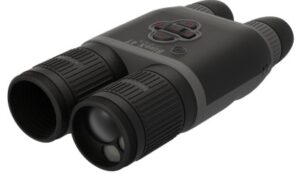 |
ATN BinoX 4T 384 2-8X | 384×288 thermal core, 2x to 8x magnification, built-in laser rangefinder, Obsidian 4 processor, Wi-Fi app streaming, video recording | Check Price |
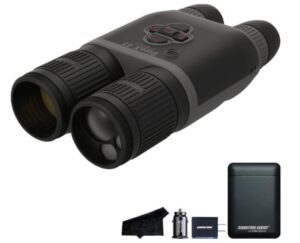 |
ATN BinoX 4T 384 4.5-18X | 384×288 thermal core, 4.5x to 18x magnification, built-in laser rangefinder, ballistic calculator, Obsidian 4 processor, Wi-Fi app streaming | Check Price |
Now that you have a snapshot of the full lineup, let us get into what truly sets each of these units apart for bird watching specifically. Birding with thermal imaging is a discipline that rewards understanding your equipment deeply, because the difference between a good thermal binocular and a great one for birding comes down to very specific performance characteristics: small target resolution, image refresh speed, color palette rendering, and the ability to track fast-moving subjects in complex environments. Every unit on this list has been chosen because it addresses those birding-specific demands in a meaningful way. Here is the full breakdown.
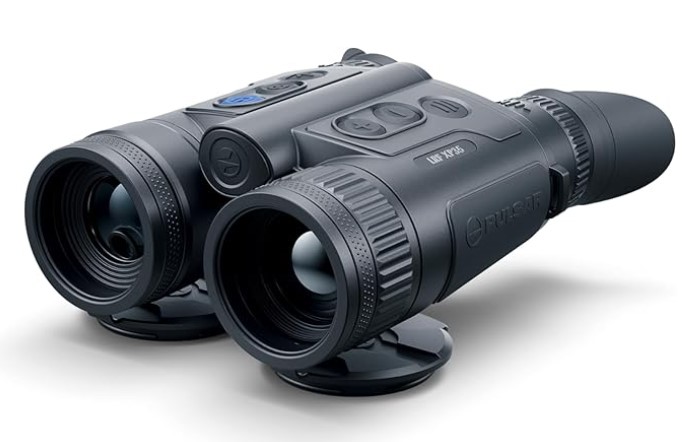
1) Pulsar Merger LRF XP35 (Best Thermal Binoculars for Bird Watching with Maximum Detail and Clarity)
Bird watching places thermal imaging equipment under a uniquely demanding set of performance requirements that quickly separate capable units from truly exceptional ones. Birds are thermally small targets compared to mammals, their rapid movement requires a fast sensor refresh rate to avoid motion blur and smearing, and meaningful species identification at any useful birding distance requires enough image resolution to distinguish body shape, wing profile, and proportional features that differentiate one species from another. The Pulsar Merger LRF XP35 meets every one of those demands at a level that no other unit on this list can fully match, and for birders who are serious about what thermal imaging can reveal about avian behavior and nocturnal bird activity, it is the benchmark against which everything else is measured.
The 640×480 thermal core at a 17 micron pixel pitch is the single most important specification for birding applications on this entire list. When you are trying to identify a hunting owl banking through a woodland edge at 200 meters, distinguish between a roosting heron and a large egret in a distant reed bed, or track a group of waders moving across a tidal flat in the dark, the resolution advantage of a 640 core over a 384 core is not a marginal improvement. It is the difference between seeing enough body geometry to make a confident identification and seeing a warm shape that could be almost anything. Experienced thermal birders who have used both sensor tiers consistently describe the step up to 640 as the single most significant image quality jump available in the consumer thermal space.
The 50Hz refresh rate ensures that fast-moving birds are rendered with smooth, blur-free motion in the display rather than the smeared, ghosted trails that slower refresh rates produce when tracking birds in flight or birds moving quickly through cover. Owls quartering a field, nightjars in active hunting flight, ducks departing a roost at first light, and shorebirds moving along a waterline all appear as cleanly resolved moving subjects rather than thermal streaks, which is what makes the difference between a satisfying observation and a frustrating one.
The magnification range from 2.5x to 20x gives birders the full observational toolkit. At 2.5x you have a wide scanning field ideal for monitoring roost sites, watching migration movement across open sky, or surveying a wetland basin for roosting concentrations. Stepping up through the zoom range lets you study individual birds in detail, assess plumage and behavioral features that support identification, and follow interesting subjects without losing them against complex backgrounds.
The built-in laser rangefinder is a genuinely useful addition for serious birders who log observation data with precise distance records, and the Wi-Fi streaming capability allows a birding group to share a remarkable sighting in real time without the animal-disturbing shuffle of passing a single binocular between observers. The IPX7 waterproof rating is essential for the coastal, wetland, and dawn-mist environments where thermal birding so frequently takes place, and the replaceable battery design ensures that a long pre-dawn vigil for owl activity or a full-night wader roost survey does not end prematurely due to battery depletion.
Key Features
| Feature | Details |
|---|---|
| Thermal Core | 640×480 at 17 micron pixel pitch |
| Lens | 35mm germanium objective |
| Magnification | 2.5x to 20x digital zoom |
| Frame Rate | 50Hz refresh rate |
| Laser Rangefinder | Built-in, up to 1000m |
| Waterproof Rating | IPX7 |
| Connectivity | Wi-Fi streaming to smartphone or tablet |
| Battery | Replaceable rechargeable battery pack |
Pros
- 640×480 core delivers the image resolution needed for confident bird species identification at meaningful birding distances
- 50Hz refresh rate renders fast-moving birds in flight and active feeding without motion blur or trailing artifacts
- Wide 2.5x to 20x zoom range covers everything from roost site surveys to detailed individual bird study
- Wi-Fi streaming enables real-time group birding observation without disturbing roosting or feeding birds
- IPX7 waterproof rating and replaceable battery handle all-weather and all-night birding sessions without compromise
Cons
- The premium 640 core and full feature set carry a price that represents a significant investment for birders who are exploring thermal imaging for the first time and are not yet certain how frequently they will use it at this capability level
The Pulsar Merger LRF XP35 is the thermal binocular that shows you birds you did not know were there and reveals behaviors that daylight optics can never capture. If detailed, confident thermal birding at the highest currently available image quality level is what you are after, go check it out. Your first night session with this unit will redefine what bird watching means to you.
2) Hikmicro Habrok 4K HE25L (Best Thermal Binoculars for Bird Watching in Woodland and Dense Vegetation)
Woodland birding presents thermal imaging with its most difficult challenge. The forest environment is thermally complex in ways that open habitats are not: sun-warmed bark, decaying logs, patches of leaf litter at different temperatures, and the constant interference of branches and foliage that block, fragment, and scatter thermal signatures from birds moving through the canopy or understory. A pure thermal image in dense woodland can feel like trying to identify birds through a mosaic of confusing heat sources, and even experienced thermal observers can struggle with false positives, missed birds, and identification uncertainty that erodes the joy of the experience. The Hikmicro Habrok 4K HE25L addresses this challenge more directly than any other unit available through its 4K optical and thermal sensor fusion technology, and for woodland birders specifically it is a genuinely transformative piece of equipment.
The fusion principle works by capturing simultaneous images from a 4K resolution optical camera and a 384×288 thermal sensor, then compositing them into a single real-time display. In woodland birding terms this means you see a bird’s heat signature precisely located within an image that also shows you the branch it is perched on, the tree it is feeding against, and the surrounding canopy structure that provides the positional context your brain needs to interpret what you are looking at. A roosting tawny owl 40 meters up in an oak becomes not just a warm shape in a thermally noisy background but a clearly positioned bird in a recognizable tree, allowing immediate identification and behavioral assessment that pure thermal simply cannot deliver in this environment.
The 4K resolution of the optical camera channel is the highest available in any consumer thermal fusion binocular, and it matters for birding specifically because the structural detail that the optical channel contributes to the fused image is what makes species identification possible in complex backgrounds. The sharper and more detailed that structural context is, the more useful the fused image becomes for the identification challenges that woodland birding presents. At any light level where the optical channel contributes meaningful information, from full daylight through deep twilight and into moonlit conditions, the 4K sensor earns its specification.
Birders who regularly observe crepuscular and nocturnal species know that some of the most exciting avian activity happens in the hours immediately surrounding sunrise and sunset, precisely the conditions where conventional binoculars struggle and thermal imaging begins to show its advantages. Nightjars sitting on warm bare ground after dark, owls moving between hunting perches at dusk, and woodcock performing roding display flights at last light are all targets that thermal imaging reveals with a clarity and completeness that would be impossible without it. The Habrok’s fusion mode makes those observations richer and more interpretable than any pure thermal alternative in this price range.
The built-in laser rangefinder supports the precise behavioral documentation that serious birders maintain, and the onboard video recording preserves behavioral sequences for review and sharing. The switchable display mode between pure thermal, pure optical, and fused composite lets you optimize the display for whichever conditions you are working in at any given moment during a session, and the Wi-Fi connectivity supports the kind of group birding experience where sharing a remarkable sighting immediately enhances the whole group’s enjoyment of the session.
Key Features
| Feature | Details |
|---|---|
| Thermal Core | 384×288 at 12 micron pixel pitch |
| Optical Camera | 4K resolution visible light camera |
| Thermal Lens | 25mm germanium |
| Display Modes | Pure thermal, pure optical, and fused composite |
| Laser Rangefinder | Built-in |
| Video Recording | Onboard recording capability |
| Connectivity | Wi-Fi app compatible |
| Color Palettes | Multiple selectable palettes |
Pros
- 4K optical and thermal fusion provides the clearest and most interpretable image in dense woodland and complex vegetation where pure thermal images become difficult to read
- Switchable display modes offer complete flexibility across changing light and habitat conditions throughout a birding session
- 12 micron pixel pitch thermal core delivers thermal image quality that performs above its sensor size class for small target detection
- Onboard video recording preserves behavioral sequences of nocturnal and crepuscular species for documentation and sharing
- Fusion mode makes roosting bird identification, canopy activity monitoring, and understory species observation dramatically more reliable
Cons
- The 25mm thermal objective produces a more limited detection range compared to 50mm alternatives, which reduces its effectiveness for open water, coastal, and large wetland birding where birds may need to be detected at several hundred meters across open ground
The Hikmicro Habrok 4K HE25L turns woodland thermal birding from a frustrating exercise in thermal interpretation into a genuinely rich observational experience where every bird in the canopy and understory is clearly positioned and identifiable in its natural environmental context. If forests, hedgerows, and dense cover are where you do your best birding, go check this unit out. It was made for exactly what you are trying to do.
3) AGM Explorator FSB50 640 (Best Thermal Binoculars for Bird Watching on Wetlands and Open Water)
Wetland and open water birding is one of the most rewarding and most thermally demanding applications in the entire bird watching discipline. Coastal estuaries, large reservoirs, tidal flats, open marshes, and lake systems routinely hold extraordinary concentrations of birds at night, many of which are entirely invisible to conventional optics after dark. Wader roosts numbering in the thousands, wildfowl flighting onto feeding areas, herons and egrets moving between roost trees and fishing grounds, and rails moving through reed beds in complete darkness are just a fraction of what thermal imaging reveals in wetland habitats that the naked eye and even image-intensified night vision simply cannot match. The AGM Explorator FSB50 640 is the unit on this list that is best equipped to capture all of it, because wetland birding rewards long-range detection and image clarity at distance above every other performance characteristic.
The combination of a 640×512 thermal core and a 50mm germanium objective lens gives the Explorator FSB50 640 a detection range and image quality at distance that is genuinely in a different league from 384 core and smaller-lens alternatives for this application. Open water and tidal flat environments offer no cover and no background clutter, which means birds appear against open thermal backgrounds and the limiting factor on observational range becomes almost entirely the optical and sensor capability of the binocular. At those ranges, the 50mm lens’s superior thermal energy collection and the 640 core’s doubled linear resolution compared to a 384 sensor combine to produce identifiable images of bird-sized targets at distances that would show only ambiguous warm blobs through lesser equipment.
Waders in particular benefit from this extended range and high resolution capability in a way that birders who have spent time on tidal flats will immediately appreciate. A roost of Knot, Dunlin, and Grey Plover packed onto a high tide refuge point 400 meters across open mudflat is a thermally rich and complex scene. Through a lower-resolution unit it appears as a mass of warm signatures without individual definition. Through the Explorator FSB50 640 individual birds at the margins of the roost become distinct, countable subjects, and the behavioral dynamics of birds arriving, jostling for position, and departing become observable and documentable in ways that transform the quality of the observation experience.
Migration watching is another wetland and open-sky birding application where this unit’s capabilities pay exceptional dividends. Nocturnal migration is one of the most underobserved phenomena in bird watching despite representing the majority of migration activity for most species. Thermal imaging pointed at an open sky during active migration nights reveals a constant stream of passerines, waders, and wildfowl moving overhead that is completely invisible to conventional observers. The Explorator’s 640 core and 50mm lens combination resolves enough body shape detail in overflying birds to make broad identification possible in many cases, opening a window into migration that thermal birding pioneers are only beginning to fully explore.
The 2.5x to 20x magnification range gives complete observational flexibility across open water and coastal environments, the multiple color palette selection allows display optimization for varying ambient temperatures and sky conditions, and the IPX7 waterproof rating handles the salt spray, mist, and rain of coastal birding without any concern.
Key Features
| Feature | Details |
|---|---|
| Thermal Core | 640×512 |
| Lens | 50mm germanium objective |
| Magnification | 2.5x to 20x digital zoom |
| Detection Range | Up to 1800m on human-sized targets |
| Color Palettes | Multiple including white hot, black hot, red hot |
| Frame Rate | 50Hz refresh rate |
| Waterproof Rating | IPX7 |
| Battery | Built-in rechargeable with USB-C charging |
Pros
- 640×512 core with 50mm lens delivers outstanding long-range bird detection across open water, tidal flats, and large wetland systems
- High resolution at distance enables wader roost counting, individual bird identification, and behavioral observation at ranges other units cannot match
- 50Hz refresh rate captures birds in flight with smooth, blur-free rendering essential for monitoring active roosts and migration movement
- Multiple color palette selection allows display optimization for open sky migration watching and varying water and coastal conditions
- IPX7 waterproof rating handles the demanding salt spray and wet conditions of coastal and wetland birding without compromise
Cons
- The physical size and weight of the 50mm lens housing makes this a larger and heavier unit than alternatives with smaller objectives, which is worth considering for birders who cover long distances on foot across marsh and coastal terrain where carrying comfort over hours matters
The AGM Explorator FSB50 640 opens up the full thermal potential of wetland, coastal, and open-sky birding in a way that nothing with a smaller lens or lower-resolution core can replicate. If tidal flats, open reservoirs, and nocturnal migration watching are where your birding ambitions lie, go check this unit out. It will show you birds moving through the night in numbers that will genuinely astonish you.
4) ATN BinoX 4T 384 2-8X (Best Thermal Binoculars for Bird Watching with Group Sharing and Recording Features)
Bird watching is one of the most social of outdoor pursuits, and the shared experience of a remarkable sighting is one of the defining pleasures of the hobby. When a rare owl appears in a spot where a group of birders has gathered, or when a pre-dawn survey of a roost site reveals an unexpected species, the natural instinct is to share what you are seeing with everyone present as immediately and vividly as possible. The BinoX 4T 384 in the 2-8x configuration addresses that social dimension of thermal birding more directly than any other unit on this list, and for birding groups, guided birding experiences, and bird clubs exploring thermal imaging together, its connected feature set makes it an exceptionally compelling choice.
The ATN Obsidian 4 processor is the technology platform that drives the BinoX 4T’s smart feature set, and for birding applications the two most relevant capabilities it enables are real-time Wi-Fi streaming to iOS and Android devices and onboard thermal video recording. The streaming function allows you to broadcast what you are seeing through the binoculars to any number of smartphones or tablets in the immediate area simultaneously, meaning that a guided group of birders can all watch the same roosting Long-eared Owl on their own screens in real time while the group leader manages the binoculars and narrates the observation. That shared experience is qualitatively different from the traditional queue-at-the-eyepiece approach, and it transforms the educational and social value of a thermal birding session considerably.
The onboard thermal video recording captures behavioral sequences in a format that is enormously valuable for bird watching beyond the immediate observation session. A thermal video of owls exchanging prey during a courtship feeding interaction, of a Bittern emerging from reed cover to hunt an open pool, or of a Woodcock performing its roding display flight over a woodland edge is a documentation resource that still photography and written notes cannot fully replicate. These recordings can be reviewed, shared with the birding community, submitted as behavioral documentation to recording committees, and used as educational material in ways that add lasting value to every observation session.
The 384×288 thermal core delivers performance that is entirely appropriate for the close to moderate range birding scenarios that the 2-8x magnification range is designed to serve. Garden birding for roosting species, local patch surveys for owl activity, hedgerow and woodland edge observation, and roost site monitoring within a few hundred meters are all applications where the 384 core provides clear, workable images and the 2x wide field gives you the situational awareness to detect and track birds efficiently across the available habitat.
It is worth noting that owls have been known to hear frequencies up to 12 kilohertz, giving them sound location capabilities that allow them to precisely locate prey beneath snow cover in complete darkness. Observing that remarkable hunting behavior through a thermal binocular, watching a Barn Owl quarter a field and plunge into snow-covered grass guided entirely by sound, is the kind of experience that thermal birding makes possible and that the BinoX 4T captures beautifully on video for lasting documentation.
The built-in rangefinder supports distance-annotated behavioral records, and the accessible price point makes this unit the most financially approachable way into connected thermal birding for individuals and groups who want the streaming and recording capability without a flagship-level investment.
Key Features
| Feature | Details |
|---|---|
| Thermal Core | 384×288 |
| Magnification | 2x to 8x |
| Processor | ATN Obsidian 4 |
| Rangefinder | Built-in laser rangefinder |
| Video Recording | Onboard thermal video recording |
| Connectivity | iOS and Android app via Wi-Fi streaming |
| Ballistic Calculator | Integrated with rangefinder data |
| Battery | Built-in rechargeable, USB-C charging |
Pros
- Real-time Wi-Fi streaming to multiple devices simultaneously enables genuine shared group thermal birding experiences for guided tours and birding clubs
- Onboard thermal video recording preserves behavioral sequences for documentation, community sharing, and educational use
- 2x to 8x magnification is ideally matched to garden, local patch, woodland edge, and roost site birding at close to moderate distances
- ATN Obsidian 4 smart platform delivers a connected feature set at a price that makes group-level thermal birding accessible
- Built-in rangefinder supports precise distance-annotated behavioral observation records
Cons
- The 8x maximum magnification and 384 core establish a practical range ceiling that makes this unit less well suited to open habitat birding where birds need to be detected and identified at distances beyond 300 to 400 meters
The ATN BinoX 4T 384 2-8X is the thermal binocular that turns a personal observation tool into a shared birding experience and a behavioral documentation platform, and for birding groups and anyone who wants to record and share what they see after dark, that combination is genuinely compelling. Go check it out and see how much richer a connected thermal birding session can be.
5) ATN BinoX 4T 384 4.5-18X (Best Thermal Binoculars for Bird Watching with Extended Zoom for Distant Species)
There is a specific category of thermal birder who will find the 4.5-18x variant of the ATN BinoX 4T 384 to be the more purposeful choice over its 2-8x sibling, and understanding who that birder is and what they are trying to accomplish clarifies exactly why this configuration earns its own place on this list despite sharing so much of its specification with the unit reviewed above. If your thermal birding regularly takes you to open habitats where birds of interest are routinely further than 300 meters away, if you observe species that respond to observer presence with early departure and require distance to allow relaxed natural behavior, or if you want the ability to study individual birds in meaningful detail at ranges that a low magnification thermal binocular simply cannot resolve, the 4.5-18x configuration was built with your requirements in mind.
The 4.5x to 18x magnification range opens up a significantly wider observational envelope than the 2-8x variant at the far end of the zoom. At 12x to 15x a 384 core is working in its productive resolution window for bird-sized targets at moderate distances, producing images with enough body geometry and shape definition to support meaningful species assessment that 8x simply cannot provide at the same ranges. At 18x you are pushing toward the upper limit of what a 384 sensor can usefully resolve, but for large bird targets like herons, raptors, and wildfowl the image quality at that magnification remains workable and sometimes provides the detail needed to confirm an identification or assess a behavioral posture that clinches an observation record.
Non-disturbance observation is one of the most practically important applications for this higher magnification range in bird watching. Many of the most rewarding birds to observe thermally are also among the most sensitive to human presence: roosting raptors that will leave a roost site if approached within 100 meters, displaying waders that abort courtship behavior at the first sign of an observer, and communal roosts of corvids and starlings that respond to any approaching figure by taking flight and relocating. Being able to observe from a position 400 to 500 meters away and still resolve enough thermal detail to meaningfully watch and document behavior is a capability that the 4.5-18x configuration delivers and that lower magnification alternatives cannot.
The complete Obsidian 4 smart platform carries over in full: the built-in rangefinder with precise distance data, the onboard thermal video recording, and the iOS and Android app connectivity with real-time Wi-Fi streaming. For birding applications, the streaming and recording capabilities that make the 2-8x variant so valuable for group and social birding work exactly the same way in the 4.5-18x, meaning you lose nothing of the connected feature set while gaining the additional reach of the higher magnification range.
Many nocturnally active bird species that are among the most sought-after targets for thermal birding are also among the most scientifically interesting from a behavioral perspective. Observing Stone Curlews on their breeding territories after dark, watching Nightjars in active hunting flight, or monitoring Barn Owl family groups during the fledgling period are experiences that thermal imaging uniquely enables and that the 4.5-18x BinoX 4T captures with a quality and at a distance that makes the observation genuinely non-intrusive and scientifically valuable.
Key Features
| Feature | Details |
|---|---|
| Thermal Core | 384×288 |
| Magnification | 4.5x to 18x |
| Processor | ATN Obsidian 4 |
| Rangefinder | Built-in laser rangefinder |
| Video Recording | Onboard thermal video recording |
| Connectivity | iOS and Android app via Wi-Fi streaming |
| Ballistic Calculator | Integrated with rangefinder data |
| Battery | Built-in rechargeable, USB-C charging |
Pros
- 4.5x to 18x magnification range enables non-disturbance observation of sensitive species from respectful distances that do not trigger flight responses
- Extended zoom ceiling allows meaningful behavioral study of open-habitat and flight-responsive species at ranges the 2-8x variant cannot cover
- Complete Obsidian 4 smart platform with streaming and recording carries over fully from the companion variant
- Ideal for observing sensitive breeding species, displaying waders, and communal roosts that require long-distance observation protocols
- Strong value for connected extended-range thermal birding capability that bridges the gap between entry-level and premium-tier performance
Cons
- The 4.5x minimum field of view is narrower than the 2x entry of the companion variant, which makes close-range wide-field scanning in garden and woodland settings slightly less comfortable for birders who regularly work in compact or intimate habitats
The ATN BinoX 4T 384 4.5-18X is the thermal birding tool that lets you get closer to the behavior you came to watch without ever physically closing the distance between you and the bird, and that respectful extended observation capability is one of the most valuable things any birding optic can offer. Go check it out and discover what the night reveals when you can observe from a distance that lets the wildlife behave naturally.
Conclusion
What genuinely excites me about thermal binoculars for bird watching right now is that we are at a turning point in the hobby. For most of birding history, the hours between dusk and dawn were effectively a closed book: you knew birds were out there moving, hunting, roosting, and displaying, but unless you stumbled into a beam of light or had a chance encounter at a roost site, that nocturnal world was largely inaccessible to the casual observer. Thermal imaging has changed that completely, and the units on this list represent the accessible frontier of that change.
Every one of these thermal binoculars unlocks a different aspect of nocturnal and crepuscular avian life that conventional optics simply cannot touch. Pre-roost gatherings, active hunting sequences, territorial interactions in complete darkness, migration streams moving overhead on clear autumn nights: these are experiences that thermal birding makes available to anyone willing to invest in the right equipment and spend time learning how to use it well.
The unit that belongs in your kit depends on where you bird, what you are trying to observe, and how you like to share the experience with others. But whichever one you choose from this list, the first night you spend watching birds through it will be one of the most memorable sessions of your birding life. Clear skies and sharp images.
See Also: 5 Best Telescopes for Adults

I’m John V. Howard, a dedicated shooter and hunter who has spent years testing rifles, scopes, and gear in the field. I write from real experience, sharing what truly works, not what’s trendy. My goal is to give you honest, practical insights that help you make the right choices for your adventures and pursuits.