
Bestscopesreviews.com is a participant in the Amazon Services LLC Associates Program, an affiliate advertising program designed to provide a means for sites to earn advertising fees by advertising and linking to Amazon.com. Read more.
Do you want to buy the best binoculars for stargazing and finally see beyond the handful of bright stars that everyone can spot? If you do, you are about to discover why binoculars are often a smarter first step into astronomy than buying a telescope, and how the right pair can unlock an entirely new perspective on the night sky that has been hiding above your head this entire time.
I have been observing the heavens for over two decades now, and I can tell you from countless nights under dark skies that binoculars remain one of the most versatile and rewarding tools in any stargazer’s arsenal. Unlike telescopes, which lock you into a narrow field of view and require extensive setup, binoculars let you sweep across the Milky Way, track satellites, watch the Moon rise over a ridge line, and pick out star clusters in Orion all within the same observing session. The wide field of view that binoculars provide makes navigation intuitive, and using both eyes creates a natural, comfortable viewing experience that single eyepiece telescopes simply cannot match.
The binoculars I am covering today range from budget friendly models that deliver stunning views of the Moon and bright deep sky objects, all the way up to premium image stabilized optics that professional astronomers genuinely rely on for serious observing work. Whether you are standing in your backyard scanning the summer triangle or sitting in a remote dark sky site hunting for the Andromeda Galaxy, there is a binocular on this list that will meet your needs and your budget.
In this guide, I will walk you through my top five picks for stargazing binoculars, cover the specific features that separate excellent astro binos from general purpose models, and answer the most common questions that new stargazers ask me about choosing and using binoculars for astronomy.
By the time you finish reading, you will know exactly which binocular belongs in your hands the next time you step outside after sunset.
Best Binoculars Comparison
| Image | Name | Key Features | Check Price |
|---|---|---|---|
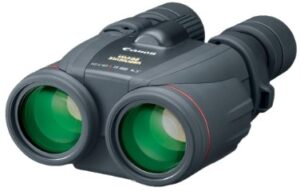 |
Canon 10x42L IS WP | 10x magnification, 42mm objectives, vari-angle prism image stabilization, ultra-low dispersion glass, 16mm eye relief, waterproof/fogproof, 6.5° field of view, tripod adaptable | Check on Amazon |
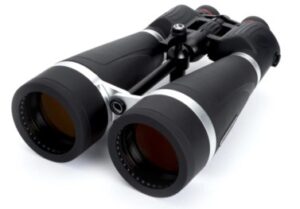 |
Celestron SkyMaster Pro 20×80 | 20x magnification, 80mm objectives, XLT fully multi-coated, magnesium chassis, waterproof/fogproof, Bak-4 porro prisms, tripod adapter with RSR rail, 3.3° field of view | Check on Amazon |
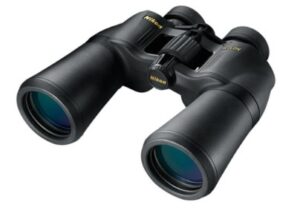 |
Nikon Aculon A211 10×50 | 10x magnification, 50mm objectives, Bak-4 porro prisms, fully multi-coated, 6.5° field of view, turn-and-slide rubber eyecups, tripod adaptable, lightweight at 32 oz | Check on Amazon |
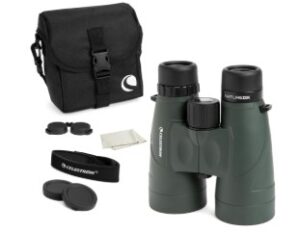 |
Celestron Nature DX 12×56 | 12x magnification, 56mm objectives, fully multi-coated BaK-4 prisms, waterproof/fogproof, phase-coated prisms, 18mm eye relief, includes harness and case | Check on Amazon |
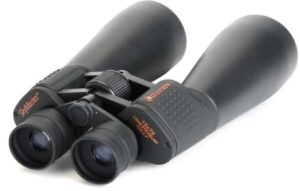 |
Celestron SkyMaster 15×70 | 15x magnification, 70mm objectives, fully multi-coated optics, Bak-4 prisms, 4.4° field of view, tripod adaptable, budget-friendly astronomy powerhouse | Check on Amazon |
Now that you have seen the lineup at a glance, let me walk you through each binocular in detail. I have personally tested these models under real night sky conditions, and I am going to share what actually matters when you are out there in the dark trying to resolve the bands of Jupiter or find Messier 13 in Hercules.
1. Canon 10x42L IS WP (Best Binoculars for Stargazing Overall)
If I could only recommend one binocular for serious stargazing, the Canon 10x42L IS WP would be that recommendation without hesitation. Canon is a Japanese imaging giant that has been building world class optical systems since 1937, and the 10x42L IS WP represents the absolute pinnacle of their binocular engineering expertise. This is the model that professional astronomers, wildlife biologists, and military observers turn to when image stability is non negotiable.
The defining feature of the Canon 10x42L IS WP is its vari-angle prism image stabilization system. This is not digital trickery or software compensation. Canon has built a mechanical stabilization platform directly into the optical path that uses gyroscopic sensors to detect hand shake and then physically adjusts the prism assembly in real time to counteract that motion.
When you press the stabilization button on the right barrel, the view instantly locks solid as if you mounted the binoculars on a tripod, and the difference is genuinely transformative. Stars that were jittering around your field of view suddenly snap into sharp, steady points of light, and faint deep sky objects that were invisible through the shake become clearly visible once the image stabilizes.
The 42mm objective lenses strike an ideal balance between light gathering capability and portability. They pull in enough photons to show you the cloud bands on Jupiter, resolve dozens of stars in the Pleiades open cluster, and reveal the subtle glow of the Orion Nebula even from suburban locations with moderate light pollution.
The 10x magnification is the sweet spot for handheld astronomy because it brings distant objects significantly closer without magnifying your hand tremor to the point where the view becomes unusable, and with the image stabilization engaged, you can comfortably use the full 10x power without fatigue.
Canon has equipped the 10x42L IS WP with ultra-low dispersion glass elements that virtually eliminate chromatic aberration. This means stars remain crisp white points with no purple or green color fringing, which is exactly what you need when trying to resolve tight double stars or study lunar craters at high contrast.
The 16mm of eye relief makes these binoculars comfortable for eyeglass wearers, and the waterproof, nitrogen purged construction means you can take them out in the dew, fog, and even light rain without worrying about internal fogging or moisture damage.
The field of view spans 6.5 degrees, which is wide enough to frame large constellations while still providing enough magnification to pick out detail. A tripod thread on the bottom of the chassis gives you the option to mount these on a standard photo tripod for extended observing sessions when you want to save your arms or share the view with companions.
Key Features
| Feature | Detail |
|---|---|
| Magnification | 10x optical magnification |
| Objective Diameter | 42mm objective lenses |
| Image Stabilization | Vari-angle prism IS system with gyroscopic sensors and mechanical prism adjustment |
| Optical Design | Porro prism II design with ultra-low dispersion (UD) glass elements |
| Lens Coatings | Fully multi-coated optics for maximum light transmission |
| Field of View | 6.5 degrees (114m at 1000m) |
| Eye Relief | 16mm, suitable for eyeglass wearers |
| Close Focus | 2.5 meters (8.2 feet) |
| Waterproofing | Fully waterproof and nitrogen purged, fogproof |
| Tripod Mount | Built-in 1/4 inch tripod thread |
| Power | 2x AAA batteries, approximately 2 hours IS runtime |
| Weight | 1.1 kg (39.2 oz) |
Pros
- Vari-angle prism image stabilization delivers rock-solid views that transform handheld stargazing capability
- Ultra-low dispersion glass eliminates chromatic aberration for crisp, color-accurate star images
- 10x magnification with 42mm objectives provides ideal balance of light gathering and magnification for astronomy
- 16mm eye relief accommodates eyeglass wearers comfortably during long observing sessions
- Waterproof and nitrogen purged construction handles dew, fog, and wet conditions without internal fogging
- Built-in tripod thread allows mounting for extended shared viewing sessions
- 6.5 degree field of view frames constellations while maintaining useful magnification
Cons
- Premium pricing puts these binoculars out of reach for casual or budget-conscious stargazers
If you are serious about stargazing and want the absolute best handheld viewing experience that current technology can deliver, the Canon 10x42L IS WP is the binocular to check out. The image stabilization alone will change how you observe the night sky, and the optical quality ensures that every photon that enters those 42mm objectives reaches your eye with maximum clarity and contrast.
2. Celestron SkyMaster Pro 20×80 (Best High-Power Binoculars for Deep Sky Stargazing)
There is a point in every stargazer’s journey where you want to push deeper into the cosmos, and the Celestron SkyMaster Pro 20×80 is the binocular built specifically for that moment. Celestron is an American company founded in 1960 that has become synonymous with amateur astronomy, and the SkyMaster Pro line represents their premium binocular platform designed from the ground up for serious deep sky observation.
The 80mm objective lenses are enormous by handheld binocular standards, and they function like twin telescopes strapped together. These massive front elements gather roughly four times more light than standard 42mm binoculars, which means you can see fainter nebulae, more distant galaxies, and significantly more stars in any given patch of sky.
The 20x magnification reaches far enough to resolve the four Galilean moons of Jupiter as distinct points of light, show you detail in the lunar terminator that 10x glass cannot touch, and pull in deep sky objects like the Andromeda Galaxy (M31) or the globular cluster M13 in Hercules with enough clarity to genuinely appreciate their structure.
Celestron has equipped the SkyMaster Pro 20×80 with their XLT fully multi-coated optical system, which is the same premium coating technology they reserve for their higher end telescope eyepieces. This multi-layer interference coating maximizes light transmission through every glass surface, resulting in bright, high contrast views even when observing faint targets against a light polluted suburban sky.
The Bak-4 porro prisms deliver superior light throughput and edge to edge sharpness compared to cheaper BK-7 glass, and the magnesium alloy chassis keeps the weight manageable while providing the structural rigidity necessary to maintain optical alignment over years of field use.
These binoculars are waterproof and nitrogen purged, so internal fogging is not a concern even when moving from a warm house out into cold night air or observing in humid coastal conditions. The included tripod adapter features an RSR rail (Reflex Sight Ready) on top, which is a thoughtful touch for advanced users who want to mount a red dot finder for easier star hopping.
At 2.27 kilograms (5 pounds), the SkyMaster Pro 20×80 is heavy enough that handheld viewing becomes tiring after a few minutes, but mounted on a stable photo tripod or parallelogram mount, these binoculars deliver views that rival small refractor telescopes at a fraction of the cost and complexity.
Key Features
| Feature | Detail |
|---|---|
| Magnification | 20x optical magnification for deep sky reach |
| Objective Diameter | 80mm objective lenses for maximum light gathering |
| Optical Coatings | XLT fully multi-coated optics for maximum light transmission |
| Prism Type | Bak-4 porro prisms for superior brightness and clarity |
| Field of View | 3.3 degrees (57.5m at 1000m) |
| Construction | Magnesium alloy chassis, lightweight yet rigid |
| Waterproofing | Fully waterproof and nitrogen purged, fogproof |
| Tripod Adapter | Included with RSR (Reflex Sight Ready) rail |
| Eye Relief | 18mm for comfortable viewing with or without eyeglasses |
| Weight | 2.27 kg (5 lbs) |
| Dimensions | 13 x 9.5 x 4 inches (330 x 241 x 102mm) |
Pros
- 80mm objectives gather four times more light than 42mm binoculars, revealing faint deep sky objects invisible to smaller apertures
- 20x magnification provides telescope-like reach for planetary detail, lunar craters, and distant clusters
- XLT fully multi-coated optics with Bak-4 prisms deliver bright, high contrast views with excellent color fidelity
- Magnesium alloy construction keeps weight manageable while maintaining optical alignment over years of use
- Waterproof and nitrogen purged design eliminates internal fogging in any weather condition
- Included tripod adapter with RSR rail supports advanced mounting and finder accessories
- Competitive pricing for an 80mm binocular with premium optical coatings and build quality
Cons
- 5 pound weight requires tripod mounting for comfortable extended viewing sessions
If you are ready to explore the deep sky and want binoculars that can show you galaxies, nebulae, and star clusters with the kind of detail that makes you understand why people fall in love with astronomy, check out the Celestron SkyMaster Pro 20×80. Mounted on a stable tripod under a dark sky, these binoculars will show you views that will genuinely take your breath away.
3. Nikon Aculon A211 10×50 (Best Budget Binoculars for Stargazing)
Not every stargazer has the budget or the need for premium optics, and the Nikon Aculon A211 10×50 proves that you do not have to spend a fortune to get genuinely good views of the night sky. Nikon is a Japanese optical manufacturer with over a century of lens making expertise, and the Aculon A211 line represents their entry level binocular platform that delivers surprisingly solid performance at a price point that makes astronomy accessible to anyone with even a modest interest in the stars.
The 50mm objective lenses are larger than the standard 42mm found on most general purpose binoculars, which gives you noticeably better light gathering capability for observing faint celestial objects after dark. The 10x magnification is the same as the Canon 10x42L IS WP, which means you are getting similar reach and detail resolution, just without the image stabilization and premium glass coatings.
For stationary objects like the Moon, star clusters, and bright nebulae, the Aculon A211 10×50 delivers views that are genuinely competitive with binoculars costing three or four times as much.
Nikon has built the Aculon A211 with Bak-4 porro prisms, which is the higher quality glass type that delivers better light transmission and sharper edge-to-edge clarity than the cheaper BK-7 prisms found in bargain bin binoculars.
The optics are fully multi-coated, which means every air-to-glass surface has received anti-reflection treatment to maximize light throughput and minimize internal flare. In practical terms, this translates to brighter images, better contrast against the black background of space, and less ghosting when observing bright objects like the Moon or Jupiter.
The Aculon A211 10×50 uses turn-and-slide rubber eyecups that adjust for viewing with or without eyeglasses, and the center focus wheel is smooth and precise enough to pull faint objects into sharp focus without overshooting.
At 32 ounces (910 grams), these binoculars are light enough to hold comfortably for extended observing sessions, although the 10x magnification does amplify hand shake, so resting your elbows on a car roof or leaning against a post helps stabilize the view. A standard tripod adapter socket on the front bridge allows mounting on a photo tripod when you want to observe hands-free or share views with family members who are new to stargazing.
Key Features
| Feature | Detail |
|---|---|
| Magnification | 10x optical magnification |
| Objective Diameter | 50mm objective lenses for enhanced light gathering |
| Prism Type | Bak-4 porro prisms for bright, sharp images |
| Optical Coatings | Fully multi-coated optics on all lenses |
| Field of View | 6.5 degrees (114m at 1000m) |
| Eye Relief | 11.5mm with turn-and-slide rubber eyecups |
| Close Focus | 3.6 meters (11.8 feet) |
| Tripod Adaptable | Standard 1/4-20 tripod socket on front bridge |
| Weight | 32 oz (910g) |
| Body Material | Lightweight, contoured rubber-armored body |
| Focus System | Smooth center focus knob with locking diopter adjustment |
Pros
- 50mm objectives provide excellent light gathering for deep sky observing at an entry level price point
- Bak-4 porro prisms with fully multi-coated optics deliver bright, high contrast views competitive with more expensive binoculars
- 10x magnification offers useful reach for lunar detail, star clusters, and bright nebulae
- Lightweight 32 oz design allows comfortable handheld viewing for extended sessions
- 6.5 degree field of view frames large sky regions for easy constellation navigation
- Tripod adaptable design supports stable mounting when sharing views with others
- Budget-friendly pricing makes serious stargazing accessible to beginners without major financial commitment
Cons
- 11.5mm eye relief may be insufficient for eyeglass wearers who need to keep their glasses on
If you want to get started with stargazing binoculars without breaking the bank, the Nikon Aculon A211 10×50 delivers genuinely impressive performance that will show you the wonders of the night sky without demanding premium pricing. Check out this binocular and discover why tens of thousands of amateur astronomers trust Nikon glass to bring the cosmos into focus.
4. Celestron Nature DX 12×56 (Best Mid-Range Binoculars for Stargazing)
The Celestron Nature DX 12×56 occupies the critical middle ground between entry level binoculars and premium astro-specific models, and it does so with a combination of features that make it one of the most versatile stargazing binoculars you can buy in the mid-price range.
While Celestron markets the Nature DX line primarily toward birders and wildlife observers, the 12×56 configuration is exceptionally well suited for astronomy, and serious stargazers have quietly been recommending this model for years.
The 56mm objective lenses are noticeably larger than the standard 50mm found on most 10x binoculars, and that extra aperture translates directly into better performance on faint deep sky targets. The larger front elements gather more photons from distant galaxies, nebulae, and star clusters, which means you can see fainter objects and resolve more detail in the targets you can already see with smaller binoculars.
The 12x magnification pushes slightly beyond the 10x that most people consider the handheld limit, but if you can brace the binoculars against a stable surface or mount them on a tripod, that extra 2x of power brings planetary detail, lunar craters, and distant open clusters significantly closer.
Celestron has equipped the Nature DX 12×56 with fully multi-coated BaK-4 prisms and phase-coated prism surfaces, which is a level of optical treatment normally reserved for significantly more expensive binoculars. Phase coating corrects the phase shift that occurs when light passes through roof prisms, resulting in sharper, higher contrast images with better fine detail resolution. This is particularly valuable when observing the Moon at high magnification, where the phase coating helps pull out subtle contrast in crater walls and mare boundaries that lower quality prisms wash out.
The Nature DX 12×56 is fully waterproof and nitrogen purged, so you can take these binoculars out in any weather condition without worrying about internal moisture or fogging. The 18mm of eye relief is generous enough to accommodate eyeglass wearers comfortably, and the twist-up eyecups lock into intermediate positions for fine tuning the eye-to-lens distance.
Celestron includes a full harness strap and a padded stuff sack in the package, which are genuinely useful accessories that show the company understands how people actually use these binoculars in the field. At around 2.3 pounds, the Nature DX 12×56 is heavy enough to benefit from tripod mounting during extended observing sessions, but light enough to carry on a hike without feeling like a burden.
Key Features
| Feature | Detail |
|---|---|
| Magnification | 12x optical magnification for enhanced detail |
| Objective Diameter | 56mm objective lenses for excellent light gathering |
| Prism Type | BaK-4 roof prisms with phase coating for superior image quality |
| Optical Coatings | Fully multi-coated optics on all lenses and prisms |
| Field of View | 5.8 degrees at 1000 yards |
| Eye Relief | 18mm with twist-up eyecups for eyeglass wearers |
| Close Focus | 6.5 feet (2 meters) |
| Waterproofing | Fully waterproof and nitrogen purged, fogproof |
| Tripod Adaptable | Standard tripod mount socket |
| Weight | 2.3 lbs (1.04 kg) |
| Included Accessories | Full harness strap and padded stuff sack |
Pros
- 56mm objectives provide excellent light gathering for faint deep sky targets while maintaining reasonable weight
- 12x magnification delivers enhanced detail on the Moon, planets, and star clusters
- Phase-coated BaK-4 roof prisms deliver sharp, high contrast images normally found only in premium binoculars
- 18mm eye relief accommodates eyeglass wearers comfortably during long observing sessions
- Waterproof and nitrogen purged construction handles dew, fog, and wet conditions without internal fogging
- Included harness strap and padded case add genuine value for field use
- Mid-range pricing delivers premium features at an accessible price point
Cons
- 12x magnification amplifies hand shake, making tripod mounting necessary for the steadiest views
If you want binoculars that bridge the gap between entry level stargazing models and premium astro-specific optics, the Celestron Nature DX 12×56 delivers exceptional optical performance, thoughtful features, and genuine versatility at a price that makes sense. Check out this binocular and see why it has become a favorite among serious amateur astronomers who refuse to compromise on quality.
5. Celestron SkyMaster 15×70 (Best Budget High-Power Binoculars for Stargazing)
The Celestron SkyMaster 15×70 has earned a reputation as the gateway drug to large aperture astronomy binoculars, and for good reason. This binocular delivers 70mm of light gathering aperture and 15x magnification at a price point that makes high power deep sky observing accessible to anyone who is serious about exploring the night sky.
While the SkyMaster line has evolved over the years with various quality control issues affecting different production runs, the core optical design remains sound, and when you get a good pair, the views are genuinely impressive for the money.
The 70mm objective lenses gather twice as much light as standard 50mm binoculars, which translates directly into the ability to see fainter stars, more detail in nebulae, and better resolution in dense star fields. The 15x magnification is powerful enough to show you the cloud bands on Jupiter, resolve the Cassini Division in Saturn’s rings when atmospheric conditions are excellent, and pull dozens of individual stars out of globular clusters that appear as fuzzy patches through 10x glass. This level of performance puts you firmly into telescope territory in terms of what you can observe, but you retain the wide field of view and intuitive two-eye viewing experience that makes binoculars so enjoyable to use.
Celestron has built the SkyMaster 15×70 with fully multi-coated optics and Bak-4 porro prisms, which are the same optical components found in binoculars costing significantly more. The porro prism design delivers a brighter, more three-dimensional image than equivalent roof prism binoculars, and the fully multi-coated lenses maximize light transmission through the optical path.
The 4.4 degree field of view is narrower than lower power binoculars, but it is still wide enough to frame large deep sky objects like the Andromeda Galaxy or the Double Cluster in Perseus within a single view.
At roughly 3 pounds (1.36 kg), the SkyMaster 15×70 sits right at the edge of what most people can handheld comfortably for more than a few minutes. The high magnification amplifies hand shake significantly, so tripod mounting is strongly recommended for serious observing sessions.
Celestron includes a tripod adapter in the package, and mounting these binoculars on a stable photo tripod or parallelogram mount transforms them into a capable deep sky instrument that can show you hundreds of Messier objects and thousands of open clusters, double stars, and nebulae.
For the price, there is simply no other binocular that delivers this much aperture and magnification while maintaining genuinely usable optical quality.
Key Features
| Feature | Detail |
|---|---|
| Magnification | 15x optical magnification for deep sky reach |
| Objective Diameter | 70mm objective lenses for strong light gathering |
| Prism Type | Bak-4 porro prisms for bright, three-dimensional images |
| Optical Coatings | Fully multi-coated optics on all lenses |
| Field of View | 4.4 degrees (77m at 1000m) |
| Eye Relief | 15mm with fold-down rubber eyecups |
| Close Focus | 13 feet (4 meters) |
| Tripod Adaptable | Includes tripod adapter for stable mounting |
| Weight | 3 lbs (1.36 kg) |
| Construction | Polycarbonate and aluminum body, rubber armored |
Pros
- 70mm objectives deliver twice the light gathering of 50mm binoculars, revealing faint deep sky objects
- 15x magnification provides telescope-like reach for planetary detail and distant clusters
- Fully multi-coated Bak-4 porro prisms deliver bright, high contrast views with excellent color fidelity
- 4.4 degree field of view frames large deep sky objects within a single comfortable view
- Included tripod adapter supports stable mounting for extended observing sessions
- Budget-friendly pricing makes large aperture astronomy accessible to beginners and casual observers
- Proven optical design has introduced thousands of stargazers to serious deep sky observing
Cons
- 3 pound weight and 15x magnification require tripod mounting for comfortable, steady viewing
If you want to explore the deep sky without spending telescope money and you are ready to commit to tripod mounting for the best views, the Celestron SkyMaster 15×70 is the binocular that will open up an entirely new universe of observable targets. Check out this budget powerhouse and discover why it remains one of the most recommended astronomy binoculars for serious beginners who are ready to see beyond the bright stars and planets.
Conclusion
Selecting binoculars for stargazing is one of the smartest investments you can make as an amateur astronomer, regardless of whether you are taking your first steps into the hobby or adding to an existing collection of telescopes and accessories. The models I have covered in this guide represent the best options available today across a wide range of budgets and observing styles, and each one excels in its specific niche.
The key to selecting the right binocular for your stargazing needs is understanding the relationship between aperture, magnification, and your observing conditions. Larger objectives gather more light and show you fainter objects, but they also add weight and bulk that may require tripod mounting.
Higher magnifications bring distant targets closer, but they also amplify hand shake and narrow your field of view. The best binocular for you is the one that balances these factors in a way that matches how you actually observe the night sky.
What I can tell you from two decades of experience under the stars is that binoculars will change how you connect with the night sky. Unlike telescopes that lock you into a narrow tunnel of view, binoculars let you sweep across the Milky Way, discover unexpected asterisms, watch satellites streak overhead, and appreciate the scale and beauty of the cosmos in a way that feels natural and immersive.
Whether you choose a budget model that opens the door to serious observing or invest in premium optics with image stabilization and professional-grade coatings, you are gaining a tool that will serve you faithfully for years of dark sky adventures.
Get yourself a good pair of stargazing binoculars, learn your constellations, download a star chart app, and head outside on the next clear moonless night. The universe is waiting up there, and now you have exactly what you need to see it clearly.
See Also: 5 Best Binoculars for Safari

I’m John V. Howard, a dedicated shooter and hunter who has spent years testing rifles, scopes, and gear in the field. I write from real experience, sharing what truly works, not what’s trendy. My goal is to give you honest, practical insights that help you make the right choices for your adventures and pursuits.