
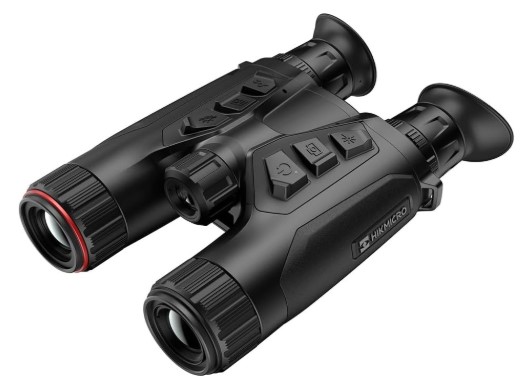
The HikMicro Habrok solves the problem every thermal hunter eventually runs into, which is that thermal alone cannot show you color, brand markings or fine daytime detail, and this review covers the Habrok Pro HQ50L configuration, the model built around a 640×512 thermal channel fused with a 4K daytime optical channel in a single binocular body. Rather than carrying a thermal unit and a daytime binocular separately, the Habrok switches between or blends both feeds, and HikMicro also sells a higher resolution HX60L configuration with a larger 1280×1024 thermal sensor for buyers who need extended detection range over the fusion convenience.
Specifications
| Spec | Detail |
|---|---|
| Thermal sensor (this config) | 640×512, 50Hz refresh rate |
| Optical day channel | 4K UHD, 3840×2160, 1/1.8 inch CMOS |
| Thermal magnification | 4.3x to 20x |
| Optical magnification | 5.5x to 22x |
| Detection range (thermal) | Approximately 2,600 meters |
| Laser rangefinder | Up to 1,000m, plus or minus 1m accuracy |
| Battery | Removable Li-ion, 9.5 to 10.5 hours with rangefinder active |
| Storage | 64GB built in |
| Weight | Approximately 975 to 1,050 grams with battery |
Optical Performance
The genuine differentiator here is the fusion between the thermal and daytime channels. During daylight or twilight, the 4K optical sensor gives you full color detail, brand markings on a target’s gear, or terrain features that thermal alone simply cannot show, while switching to thermal or a blended fusion view picks up heat signatures the moment light fails. This is a fundamentally different value proposition from a thermal only binocular, and it genuinely eliminates the need to carry a separate daytime optic alongside your thermal unit.
On thermal performance alone, the 640×512 sensor in the HQ50L configuration reviewed here delivers a published detection range around 2,600 meters, which is genuinely strong, and HikMicro’s Image Pro 2.0 processing produces noticeably clean, well contrasted thermal imagery. As with any thermal spec, that detection figure describes spotting a heat signature rather than confirming identity at that distance. Buyers who need still more detection range should look at the HX60L configuration with its larger 1280×1024 sensor, though that unit trades some frame rate for the higher resolution.
Rangefinder and Controls
The integrated laser rangefinder reaching out to 1,000 meters with plus or minus 1 meter accuracy is genuinely precise, and having it built into the same unit that handles both thermal and daytime observation removes yet another separate device from your kit. The 0.49 inch OLED display at 1920×1080 is sharp enough to do the dual channel imagery justice, which matters more here than on a thermal only unit since you are relying on it for genuine daytime detail as well.
Build Quality and Durability
At just over 2 pounds with the battery installed, the Habrok Pro is noticeably heavier than a thermal only binocular, a fair tradeoff given it is functionally replacing two devices. Battery life between 9.5 and 10.5 hours with the rangefinder active is genuinely strong for a unit running this much sensor hardware simultaneously, and the removable battery pack lets you carry spares for extended sessions.
Who Should Buy This Scope
This suits a hunter or professional observer who genuinely needs both daytime color detail and thermal capability in the same outing and does not want to carry two separate optics. The value proposition is strongest for anyone who currently owns both a dedicated daytime binocular and a separate thermal unit and wants to consolidate into one device.
A hunter who only ever glasses after dark and has no real use for the daytime channel would get better thermal only value from a Pulsar Merger or ATN BinoX at a lower price for equivalent thermal performance.
Pros
- Genuine fusion of 4K daytime optical and thermal channels in one binocular, a real category difference from thermal only units
- Strong 2,600 meter thermal detection range on this configuration
- Precise integrated laser rangefinder to 1,000 meters
- Ample 64GB onboard storage and strong battery life for the feature set
Cons
- Meaningfully heavier and pricier than a thermal only binocular, and the daytime channel adds little value for hunters who only glass after dark
If carrying one device instead of two for both daytime and thermal observation is genuinely what you need, the Habrok is worth serious consideration. Check the current listing for the configuration that matches your detection range needs.
Alternatives to Consider
| Alternative | When it’s the better choice |
|---|---|
| Pulsar Merger LRF XP50 | You only need thermal and want a lower price for equivalent sensor performance |
| ATN BinoX 4T | You want a broader smart sensor ecosystem over daytime fusion |
| AGM Taipan V2 | You want a monocular format and a significantly lower price |
Frequently Asked Questions
What does multi-spectrum or fusion actually mean on the Habrok?
It means the unit combines a thermal sensor and a separate 4K daytime optical sensor in one body, letting you switch between or blend thermal and true color imagery rather than carrying two separate optics for day and night use.
What is the difference between the HQ50L and HX60L configurations?
The HQ50L uses a 640×512 thermal sensor at 50Hz, while the HX60L steps up to a 1280×1024 thermal sensor at 25Hz for greater detection range and resolution at the cost of a slower refresh rate.
How accurate is the built in rangefinder?
HikMicro states plus or minus 1 meter accuracy out to 1,000 meters, genuinely precise and comparable to a dedicated standalone laser rangefinder.
Is the daytime channel actually necessary for hunting?
It depends on how you hunt. For anyone glassing across a full day into dusk, having true color daytime detail alongside thermal capability in one unit is a genuine convenience. A hunter who exclusively glasses after dark will get more thermal performance per dollar from a thermal only unit instead.
Verdict
The HikMicro Habrok occupies a genuinely different category from a standard thermal binocular by fusing a 4K daytime channel with a strong thermal sensor in one body. For a hunter or professional who values that dual capability and wants to consolidate two devices into one, it delivers real, differentiated value, even at a premium price over thermal only alternatives.
See Also: AGM Taipan V2 Review

I’m Jake, a dedicated shooter and hunter who has spent years testing rifles, scopes, and gear in the field. I write from real experience, sharing what truly works, not what’s trendy. My goal is to give you honest, practical insights that help you make the right choices for your adventures and pursuits.

