
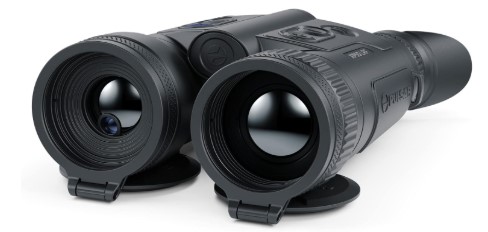
The Pulsar Merger LRF XP50 solves a problem that handheld thermal monoculars never quite manage, which is comfortable, fatigue free glassing over a long night in the field, and this review covers the binocular format model built around the 640×480 XP50 sensor with an integrated laser rangefinder. Pulsar makes its name on sensor quality and this unit backs that reputation up, delivering genuinely sharp thermal imaging in a form factor that lets you scan for hours without the single eye strain that handheld monoculars produce.
Specifications
| Spec | Detail |
|---|---|
| Sensor resolution | 640×480, 17 micron pixel pitch |
| NETD | Under 25mK |
| Frame rate | 50Hz |
| Magnification | 2.5x to 20x variable |
| Display | 1024×768 AMOLED |
| Laser rangefinder | Built in, single and continuous scan modes |
| Battery | Built in Li-ion plus removable APS3 pack, up to 10 hours |
| Weight | 28.2 ounces |
| Waterproof rating | IPX7 |
Optical Performance
The 640×480 sensor with a fast F1.0 germanium lens produces genuinely crisp thermal detail, and Pulsar’s published detection range of roughly 1,968 yards is consistent with what this sensor and lens combination should deliver on a typical animal sized target under good conditions. As with every thermal spec, that detection figure describes spotting a heat signature rather than confirming species at that distance, with recognition and identification happening considerably closer.
The AMOLED display is a genuine strength here, delivering rich contrast and color that makes extended glassing sessions noticeably less fatiguing than the LCD panels found in cheaper units. Eight color palette options let you match the display to conditions, and the variable 2.5x to 20x magnification range covers everything from close scanning to extended distance identification without switching devices.
Rangefinder and Controls
The built in laser rangefinder is the feature that separates this unit from thermal binoculars without integrated ranging, giving genuinely precise distance measurements past 1,000 yards in both single shot and continuous scanning modes. For anyone who currently carries a separate rangefinder alongside a thermal binocular, this consolidates two tools into one and removes a step from the field workflow.
Interpupillary distance adjustment from 56 to 71mm accommodates a wide range of users comfortably, a detail that matters more than it sounds for anyone who has used a poorly fitted binocular for an extended session.
Build Quality and Durability
The reinforced magnesium alloy housing feels genuinely solid without excessive weight, and the IPX7 waterproof rating covers rain and incidental water exposure confidently, though it stops short of full submersion. Operating range from negative 25 to positive 50 degrees Celsius covers realistic hunting conditions across most of the country through all seasons.
Stream Vision 2 app connectivity over dual band WiFi lets you pull photos and video directly to your phone, and the 16GB of cloud storage included is a genuinely useful touch for anyone documenting hunts or reviewing footage afterward.
Who Should Buy This Scope
This is the right choice for a serious predator or hog hunter who spends real time glassing rather than quick scans, and who wants a rangefinder built in rather than carried separately. The binocular format specifically suits anyone who has found handheld monoculars fatiguing over a full night in the field.
Anyone who needs a rail mounted riflescope rather than a handheld or binocular observation tool should look at Pulsar’s Thermion or Talion lines instead, since the Merger is purpose built for glassing rather than shooting through.
Pros
- Genuinely sharp AMOLED display reduces eye fatigue on long glassing sessions
- Built in laser rangefinder consolidates two tools most hunters currently carry separately
- Strong 10 hour battery runtime with a hot swappable APS3 pack
- Comfortable, well built binocular form factor with adjustable interpupillary distance
Cons
- Premium price reflects the binocular format and integrated rangefinder
- Heavier than a comparable handheld monocular, which matters for pack weight on long hunts
If fatigue free glassing with a built in rangefinder is what your hunting actually demands, the Merger LRF XP50 is worth a serious look. Check the current listing to see if it fits your kit.
Alternatives to Consider
| Alternative | When it’s the better choice |
|---|---|
| Pulsar Telos LRF XP50 | You want a monocular format for lighter pack weight |
| ATN BinoX 4T | You want a lower price point in a binocular format |
| Pulsar Thermion 2 XP50 | You need a rail mounted riflescope rather than a handheld |
Frequently Asked Questions
What is the detection range of the Merger LRF XP50?
Pulsar publishes a detection range of approximately 1,968 yards for an animal sized heat signature under good conditions. Practical recognition of what you are looking at happens at a considerably shorter distance than the detection figure.
How accurate is the built in laser rangefinder?
The integrated LRF provides genuinely precise measurements past 1,000 yards in both single and continuous scan modes, comparable to a dedicated handheld laser rangefinder rather than the less precise stadiametric estimation found on cheaper thermal units.
Is the Merger waterproof?
It carries an IPX7 rating, which covers rain and incidental water exposure well, though it is not rated for full submersion.
How does battery life compare to other thermal binoculars?
Up to 10 hours on the combined built in and removable APS3 battery system is genuinely strong for this category, and carrying a spare APS3 pack extends a night hunt indefinitely.
Verdict
The Pulsar Merger LRF XP50 earns its premium price through a genuinely sharp AMOLED display, a properly integrated laser rangefinder, and a binocular format built for long glassing sessions rather than quick scans. For a serious predator or hog hunter who values comfort and precision over the lowest possible price, it remains one of the strongest thermal binoculars available today.
See Also: Monstrum G3 FFP Review

I’m Jake, a dedicated shooter and hunter who has spent years testing rifles, scopes, and gear in the field. I write from real experience, sharing what truly works, not what’s trendy. My goal is to give you honest, practical insights that help you make the right choices for your adventures and pursuits.

