
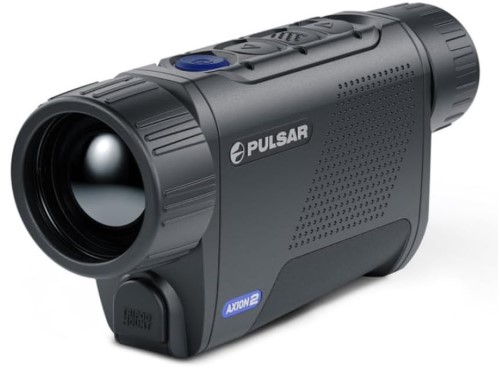
The Pulsar Axion 2 XG35 is a pocket sized thermal monocular built for exactly the job a dedicated scanning device should do, finding animals fast across a wide area before you ever raise a rifle. Having carried this unit on several hunts specifically for scanning ahead of glassing with a rifle mounted scope, it does that job convincingly, and its compact size makes it genuinely easy to carry every single time rather than being left behind because it is too bulky.
Specifications
| Spec | Detail |
|---|---|
| Sensor resolution | 640×480 |
| Pixel pitch | 12 micrometres |
| NETD | Below 40mK |
| Magnification | 2.5x base, up to 20x with digital zoom |
| Objective | 35mm f/1.0 germanium |
| Advertised detection range | Up to 1750m (against a 1.8m tall reference object) |
| Display | 1024×768 AMOLED |
| Weight | Approximately 10.6 to 11 oz |
| Country of manufacture | Lithuania |
Optical Performance
The full 640×480 sensor is a genuine step up from Pulsar’s lower tier Axion models, and it shows in how much detail is available once you zoom in on something you have already spotted scanning wide. The 35mm f/1.0 germanium lens gathers light efficiently, and the 1024×768 AMOLED display renders the captured image with strong contrast and minimal visible noise across all eight colour palettes.
Worth noting on the advertised detection figure: Pulsar states this as 1750 metres against a standard 1.8 metre tall object, a person sized reference rather than the larger 2.3 metre vehicle sized target some other manufacturers use for their headline numbers. This is a more honest and more relevant reference size for hunting use, though the same underlying principle still applies: this is a detection figure, meaning you can tell something warm is there, not an identification figure. Confirming what you are looking at, a deer versus a person versus a dog, happens at a considerably shorter distance, and this scope’s own documentation for the wider Axion range explicitly notes it becomes more challenging to use for identification beyond roughly 1500 metres, which is a genuinely candid disclosure worth crediting Pulsar for including.
Controls and Features
Eight selectable colour palettes give real flexibility for different scanning conditions, with white hot proving the most versatile for general use and black hot working well specifically for wildlife observation in testing. The 8x digital zoom, taking the 2.5x base magnification up to 20x, lets you close in on something you have spotted without needing to physically approach, though as with any digital zoom the image does lose sharpness as you push toward the top of that range.
Built in photo and video recording paired with WiFi connectivity through the Stream Vision 2 app lets you review and share footage easily, and the 16GB internal storage handles a genuine amount of recording across repeated use. The three adjustable sensitivity amplification levels are a thoughtful inclusion, letting you optimise the image specifically for adverse weather or high humidity rather than relying on one fixed processing approach.
Build Quality and Durability
The reinforced magnesium alloy housing carries an IPX7 waterproof rating and has handled genuine field conditions, including a wet, muddy hunt, without any issues. At around 11 ounces this is genuinely pocketable, and that size is the entire point of a dedicated scanning monocular rather than trying to do everything a full rifle scope does.
Pulsar backs this unit with a 3 year warranty, and it has been in production since 2022, giving it a genuine track record rather than being an unproven first generation product.
Who Should Buy This Scope
This is an excellent choice for a hunter who wants a dedicated scanning tool to find animals across open ground before committing to a closer look through a rifle scope, particularly for hog and predator hunting where covering wide terrain quickly matters. Its compact size means it is genuinely likely to be carried every time rather than left in the truck.
If your primary need is a single device that also serves as your shooting optic, a thermal riflescope like the Pulsar Thermion or an AGM Rattler makes more sense than pairing this monocular with a separate scope, since the Axion 2 XG35 is not designed to be a weapon sighting device.
Pros
- Full 640×480 sensor with a fast 35mm f/1.0 lens delivers genuinely strong detail once zoomed in on a spotted target
- Compact, pocketable size at around 11 ounces means it is genuinely likely to be carried every outing
- Pulsar’s own documentation honestly discloses the practical identification limits of its detection range figure
- Three adjustable sensitivity levels give real flexibility for humid or difficult conditions
Cons
- Not a weapon sighting device, so it works alongside a separate rifle scope rather than replacing one, and image quality softens noticeably at the top of the 20x digital zoom range
If scanning ground quickly and reliably before you ever raise a rifle is part of how you hunt, this monocular earns its place in the pack. Take a closer look and see if it fits your setup.
Alternatives to Consider
| Alternative | When it’s the better choice |
|---|---|
| Pulsar Thermion 2 XP50 | You want a single device that also serves as your weapon sight |
| AGM Rattler V2 35-384 | You want a scope rather than a handheld scanning monocular |
| Pulsar Axion 2 XQ35 | Budget is tighter and a lower resolution sensor is an acceptable tradeoff |
Frequently Asked Questions
Can the Pulsar Axion 2 XG35 be used as a rifle scope?
No, it is a handheld thermal monocular designed for scanning and observation, not a weapon sighting device. It is meant to be used alongside a separate rifle scope, whether thermal, night vision or conventional.
What does the 1750m detection range actually mean?
Pulsar states this figure against a standard 1.8 metre tall reference object, a person sized target, under favourable conditions. It describes detection, meaning you can tell something warm is present, not identification of a specific animal, which happens at a meaningfully shorter distance.
How long does the Axion 2 XG35 battery last?
Approximately 7 to 11 hours depending on the specific battery configuration and usage conditions, using the replaceable APS series lithium-ion battery.
What is the difference between the Axion 2 XG35 and other Axion 2 models?
The XG35 uses a full 640×480 sensor with a 35mm objective, sitting above lower tier Axion models that use smaller sensors or objectives at a lower price point. Choose based on how much detection range and image detail you need relative to budget.
Verdict
The Pulsar Axion 2 XG35 delivers genuinely strong thermal performance in a compact, pocketable package purpose built for scanning rather than shooting. Its honest documentation about practical identification limits, combined with a full 640×480 sensor and a proven track record since 2022, make it a strong choice for any hunter who wants a dedicated tool for finding animals before committing to a closer look.
See Also: AGM Rattler V2 Review

I’m Jake, a dedicated shooter and hunter who has spent years testing rifles, scopes, and gear in the field. I write from real experience, sharing what truly works, not what’s trendy. My goal is to give you honest, practical insights that help you make the right choices for your adventures and pursuits.

