
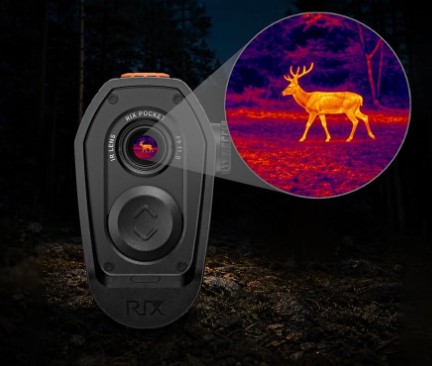
Understanding how thermal imaging works clears up almost every point of confusion a first time buyer has about these devices, from why they cost so much to why the picture looks nothing like a photograph. Thermal imaging does not amplify light the way night vision does. It does not need any light at all. It builds a picture purely from heat, which means it works identically at noon and at midnight, through smoke, and in total darkness. That single fact explains almost everything else about how these devices behave and why they cost what they do.
Everything Warm Glows in Infrared
Every object above absolute zero emits infrared radiation as a natural consequence of its temperature, a phenomenon known as blackbody radiation. Hotter objects emit more of this radiation and at shorter wavelengths, while cooler objects emit less and at longer wavelengths. A living animal, a running engine, a sun warmed rock and the cold night sky are all constantly radiating infrared energy, just at very different intensities.
Thermal imaging works in what is called the long wave infrared band, roughly 8 to 14 micrometres, because that is the wavelength range where objects at everyday temperatures radiate most strongly. This is a completely different part of the spectrum from the near infrared light used by night vision illuminators, and it is why the two technologies need entirely different hardware.
Why the Lens Looks Strange
Ordinary camera and scope glass, made from standard optical glass, is essentially opaque to long wave infrared radiation. It simply will not pass through.
Thermal devices instead use lenses made from germanium, a semiconductor material that is transparent to long wave infrared while blocking visible light almost entirely. This is why a thermal lens often looks dark or mirrored to the naked eye even though it is perfectly clear to the sensor behind it. Germanium is also expensive and delicate to work with, which is one of the main reasons thermal optics cost significantly more than comparable visible light optics.
Sensor
Behind the germanium lens sits the detector, a grid of tiny elements arranged in a pattern much like a digital camera sensor, except each element responds to infrared radiation rather than visible light.
Almost all modern consumer thermal devices use an uncooled microbolometer. Each pixel in the array is built from a material whose electrical resistance changes very slightly as its temperature changes. Incoming infrared radiation heats that pixel by a tiny amount, its resistance shifts in response, and the device measures that shift electronically. Do this simultaneously across every pixel in the array and you have a complete temperature map of the scene, refreshed many times per second.
Older and specialised thermal systems, mostly military or scientific, use cooled detectors that operate at cryogenic temperatures for greater sensitivity. These are far more expensive and much less common in hunting or civilian optics, largely because the cooling system adds bulk, cost and complexity that uncooled microbolometers avoid.
From Temperature Map to Picture
The raw output of the sensor is not an image at all. It is a grid of numbers, each one representing the relative temperature that pixel detected.
The device’s internal processor converts that grid into a visible picture by assigning a colour or a shade of grey to each temperature value, a process called false colouring since none of it reflects actual visible colour. In white hot mode, warmer objects appear light and cooler objects appear dark. Black hot mode reverses this. Many devices also offer red hot or other colour palettes that highlight the warmest objects in the scene while rendering the background in grey tones, which some users find easier to interpret quickly.
The processor also applies noise reduction, contrast enhancement and sometimes edge sharpening to make the final image more usable, which is why image processing quality varies so much between otherwise similar sensors.
What Determines Image Quality
Several factors combine to produce the final picture, and understanding them explains why two units with the same headline resolution can look very different in the field.
- Resolution is the pixel count of the sensor array, commonly 384 by 288, 640 by 480 or higher. More pixels mean more detail and generally more usable range.
- NETD, or noise equivalent temperature difference, measures how small a temperature difference the sensor can distinguish from its own internal electrical noise. Lower is better, and this figure matters enormously in humid or low contrast conditions.
- Refresh rate, typically 30 or 50 hertz, determines how smoothly the image updates. A moving target can appear to lag or stutter on a slower refresh rate.
- Pixel pitch, the physical size of each sensor element, affects how much detail can be packed into a given sensor size, with smaller pitch generally allowing higher resolution in the same physical footprint.
Why Thermal Sees Some Things and Not Others
Because thermal responds to temperature differences rather than light, it behaves in ways that surprise people used to visible light optics.
Glass and water are largely opaque to long wave infrared, which is why you cannot see clearly through a window or into a pond using thermal. Thin vegetation, on the other hand, often allows enough infrared radiation to pass or lets heat bleed through it, which is why a warm animal in light brush can still produce a visible signature even though it would be invisible to the eye.
Thermal contrast, meaning the temperature difference between an object and its background, drives visibility more than anything else. A warm animal against cold ground at dawn stands out sharply. The same animal on ground that has been heated by the afternoon sun can nearly disappear because the temperature difference has shrunk to almost nothing.
Common Mistakes
- Expecting thermal to work like a camera. It renders heat, not light, so colours, fine surface detail and anything behind glass or water will not appear the way they would in a photograph.
- Assuming thermal sees through solid objects. It does not see through walls, thick vegetation or water. Only genuinely thin material allows enough heat transfer to produce a signature.
- Thinking all thermal sensors are equivalent at the same resolution. NETD, pixel pitch, refresh rate and processing quality all affect the final image as much as raw pixel count.
- Ignoring thermal contrast. The same animal can be highly visible at dawn and nearly invisible on hot afternoon ground, purely because the background temperature has changed.
Frequently Asked Questions
Does thermal imaging work in complete darkness?
Yes, perfectly, because it does not use any ambient light at all. It detects heat directly, so darkness has no effect on its performance whatsoever, unlike night vision which needs some light to amplify.
Can thermal imaging see through walls?
No. Solid building materials block long wave infrared radiation almost completely. What thermal can sometimes do is detect a heat signature bleeding through thin material like light vegetation, but a wall, a door or a vehicle body will stop it entirely.
Why are thermal lenses so expensive?
Because ordinary glass does not transmit long wave infrared radiation, thermal devices require lenses made from germanium, a costly semiconductor material that is difficult to shape and coat. This is one of the largest cost drivers in any thermal device, alongside the sensor itself.
What is the difference between thermal imaging and night vision?
Night vision amplifies existing visible and near infrared light to produce a picture, so it needs some light source to work with. Thermal imaging detects heat radiation directly and needs no light at all, working identically day or night. They use entirely different sensor technology and different optics.
Does weather affect thermal imaging?
Yes. Rain, fog and high humidity absorb infrared radiation along the path between the target and the sensor, which reduces effective range and contrast. Heavy rain in particular can noticeably degrade thermal performance, even though the sensor itself is working normally.
Summary
Thermal imaging detects the infrared radiation that every object emits as a function of its own temperature, using germanium lenses that pass long wave infrared while blocking visible light, and an uncooled microbolometer sensor that converts tiny temperature variations into an electronic signal. A processor then converts that temperature map into a viewable image using false colour palettes like white hot or black hot.
Because it needs no ambient light, thermal works identically day or night. Because it responds to temperature rather than light, it behaves differently from a camera, rendering some materials invisible and others surprisingly transparent. Image quality depends on resolution, NETD, refresh rate and processing quality together, not any single specification alone.
See Also: Exit Pupil Explained

I’m Jake, a dedicated shooter and hunter who has spent years testing rifles, scopes, and gear in the field. I write from real experience, sharing what truly works, not what’s trendy. My goal is to give you honest, practical insights that help you make the right choices for your adventures and pursuits.

