
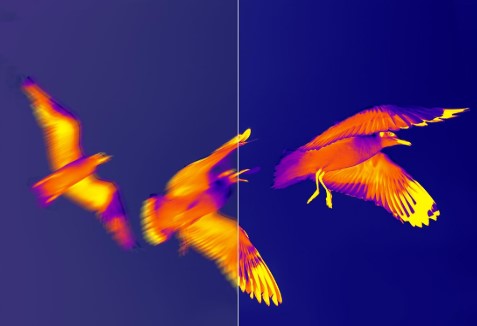
Thermal scope refresh rate is one of those specifications that sounds minor on a spec sheet and then turns out to matter enormously the first time you try to track a running coyote through one. Refresh rate describes how many times per second the display updates with a new image, most commonly either 30 or 50 times, sometimes written as 30Hz or 50Hz, or occasionally as 25Hz or 60Hz depending on the model and market. A higher number means a smoother, more fluid picture, and the practical difference between the two common options is far more noticeable than the numbers alone suggest.
What Refresh Rate Measures
Every thermal sensor captures the scene in a series of individual frames, exactly like a video camera, and then displays those frames in sequence to create the impression of continuous motion. Refresh rate is simply how many of those frames are captured and shown per second.
At 30Hz, the display updates thirty times every second, meaning roughly 33 milliseconds pass between frames. At 50Hz, the display updates fifty times per second, with only about 20 milliseconds between frames. That gap of just over ten milliseconds does not sound like much written down, but your eye and brain are extremely sensitive to motion smoothness, and the difference is genuinely visible in real use.
Why It Matters More on a Moving Target
On a stationary target, refresh rate barely matters. A bedded hog or a coyote sitting still looks essentially identical whether the display is updating thirty or fifty times a second, because there is nothing changing between frames to smooth out.
The difference appears the moment something moves. A running animal on a 30Hz display can appear to judder or lag slightly behind its true position, with a faint trailing effect between frames that some users describe as looking slightly choppy or stepped. On a 50Hz display, the same moving animal tracks far more smoothly, closer to how your eye naturally perceives motion.
This matters practically in two ways. First, it is simply easier to keep a moving target centred in the reticle when the image is updating more often, because you are working with more up to date positional information at every instant. Second, for anyone shooting at a moving target rather than a stationary one, a smoother, more current image translates into a more confident and more accurate shot.
Where 30Hz Is Perfectly Fine
It would be a mistake to write off 30Hz entirely, because for a large share of thermal use it performs perfectly well.
Scanning a field for stationary or slow moving animals, glassing a treeline, or watching a feeder are all tasks where 30Hz delivers a completely usable image. Most detection work, which is the majority of what a thermal device is actually used for across an evening, does not depend heavily on refresh rate at all.
30Hz units are also generally less expensive and draw less power, both genuine practical advantages for anyone budget conscious or planning long sits away from a charging point.
Where 50Hz Earns Its Keep
The advantage becomes clear specifically when tracking movement, most obviously with running hogs, sprinting coyotes, or any fast moving target at the moment a shot is being taken. If your hunting regularly involves shooting at animals in motion rather than stationary ones, 50Hz is a genuine functional upgrade rather than a marketing number.
It is also worth noting that some jurisdictions and export regulations treat 60Hz and above differently from 30Hz for civilian sale, which is part of why 50Hz has become a common middle ground offered by several manufacturers rather than the full 60Hz some military systems use.
What Refresh Rate Does Not Fix
It is easy to assume a higher number solves every problem, and it does not. Refresh rate has no effect on resolution, meaning it will not make a low pixel count sensor show more detail. It has no effect on NETD, meaning it will not improve how well the sensor performs in humid or low contrast conditions. And it has no effect on detection range, which is driven mainly by resolution and lens focal length.
A 50Hz unit with a low resolution sensor and poor sensitivity will still be outperformed in most respects by a well specified 30Hz unit. Refresh rate is one factor among several, and it specifically addresses motion smoothness rather than image quality as a whole.
| Scenario | Refresh rate that matters most |
|---|---|
| Scanning for stationary or slow moving game | 30Hz is fine |
| Shooting running hogs or coyotes | 50Hz noticeably helps |
| Static watch over a feeder or field | 30Hz is fine |
| Fast moving predator calling scenarios | 50Hz noticeably helps |
| Budget or long battery life priority | 30Hz is the more practical choice |
Common Mistakes
- Assuming refresh rate is the same as resolution. They are unrelated specifications, and a high refresh rate on a low resolution sensor will not deliver a detailed image, only a smooth one.
- Overpaying for 50Hz when your hunting is mostly stationary target detection. If you primarily scan and confirm rather than track fast moving animals, the extra cost may not translate into a meaningful practical benefit for you.
- Underestimating the difference on genuinely fast targets. Shooters who move from a 30Hz unit to a 50Hz one after hunting running hogs regularly often describe it as a bigger practical upgrade than the numbers suggest on paper.
- Ignoring battery life tradeoffs. Higher refresh rate generally draws more power, which is worth factoring into your planning for extended sits.
Frequently Asked Questions
Is 50Hz worth the extra cost over 30Hz?
It depends heavily on what you hunt. If running hogs or fast moving predators are a regular part of your hunting, the smoother tracking that 50Hz provides is a genuine practical benefit worth paying for. If most of your use is scanning and confirming stationary or slow moving animals, 30Hz will serve you well and save money that could go toward better resolution or NETD instead.
Does refresh rate affect detection range?
No, not directly. Detection range is driven mainly by sensor resolution and lens focal length. Refresh rate only affects how smoothly motion is displayed, not how far the sensor can resolve a target.
Can I notice the difference between 30Hz and 50Hz with the naked eye?
Yes, particularly on moving targets. Human vision is quite sensitive to motion smoothness, and the roughly ten millisecond difference in frame timing between the two rates is genuinely perceptible, especially when tracking something moving quickly across the field of view.
Why do some thermal scopes only offer 30Hz?
Often for cost reasons, since higher refresh rate sensors and the processing to support them add expense. In some cases it also relates to export regulations that historically treated higher frame rate thermal technology differently for civilian sale, which shaped what manufacturers commonly offer at different price points.
Does higher refresh rate drain the battery faster?
Generally yes, since capturing and processing more frames per second requires more continuous power. If extended battery life for long sits matters more to you than smooth tracking of fast moving targets, that tradeoff is worth weighing when choosing between the two.
Summary
Refresh rate describes how many times per second a thermal display updates, most commonly 30 or 50 times. The difference is barely noticeable on stationary targets and clearly noticeable on moving ones, where 50Hz delivers smoother, more trackable motion at the cost of higher price and shorter battery life.
Choose 50Hz if fast moving targets, particularly running hogs or coyotes, are a regular part of your hunting. Choose 30Hz if your use is mostly scanning and detection of stationary or slow moving animals, and put the savings toward better resolution or a lower NETD instead, since neither of those improvements comes from refresh rate at all.
See Also: Where Are Vortex Scopes Made?

I’m Jake, a dedicated shooter and hunter who has spent years testing rifles, scopes, and gear in the field. I write from real experience, sharing what truly works, not what’s trendy. My goal is to give you honest, practical insights that help you make the right choices for your adventures and pursuits.

