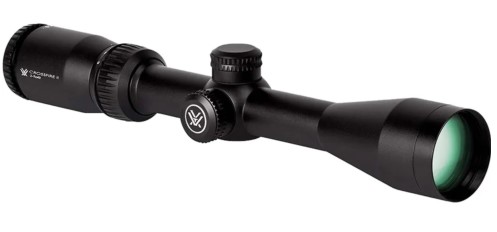
If you have wondered what 3-9×40 means on a scope, the answer is simpler than the number makes it look. The 3-9 is the magnification range, meaning the scope can make the target appear anywhere from three to nine times closer than it really is. The 40 is the diameter of the front lens in millimetres. That is the whole code. Every variable power rifle scope on the shelf uses the same convention, so once you can read one of these numbers you can read all of them, and you can start making sensible comparisons instead of guessing.
Breaking Down the Numbers
Take the number apart into three pieces.
- The first number, 3, is the lowest magnification. At this setting the target looks three times closer than it does to your naked eye. Low magnification gives you a wide field of view, which is what you want when you are trying to find an animal in thick cover or track something that is moving.
- The second number, 9, is the highest magnification. Nine times closer, with a much narrower field of view. This is for identifying detail, picking a precise aiming point, or shooting at distance.
- The number after the x, 40, is the objective lens diameter in millimetres. That is the lens at the far end of the scope, the one pointing at the target. A larger objective gathers more light, which matters most at dawn and dusk.
So a 3-9×40 is a variable power scope adjustable from 3x to 9x with a 40mm front lens. A 4-16×50 goes from 4x to 16x with a 50mm objective. A 6-24×56 is a high magnification scope with a large light gathering lens.
Fixed Power Scopes
Some scopes show only one magnification number, such as 4×32 or 6×42. These are fixed power scopes with no zoom ring. They have fewer moving parts, which historically meant better durability and better optical quality for the money, and they remain popular on dangerous game rifles and rimfires.
The tradeoff is obvious. You get one magnification and you live with it. For most shooters the flexibility of a variable is worth more than the marginal robustness gain.
Why the Zoom Ratio Matters
Divide the top magnification by the bottom and you get the zoom ratio. A 3-9×40 is a 3x zoom. A 5-25×56 is a 5x zoom. A 1-8×24 is an 8x zoom.
Higher ratios give you more flexibility from a single scope, letting you go from close quarters to distance without swapping optics. They are also harder and more expensive to build well. Stretching a wide zoom range while keeping the image sharp edge to edge, keeping the eye box forgiving and keeping the tracking honest takes better glass and tighter tolerances. A cheap 6x zoom scope will usually be beaten by a good 3x zoom scope at the same price.
The Objective Lens Tradeoff
Bigger objectives gather more light, but the benefit is not unlimited and it comes with real costs.
The useful measure here is exit pupil, which is the diameter of the column of light leaving the eyepiece and entering your eye. Calculate it by dividing the objective diameter by the magnification. A 3-9×40 at 9x gives an exit pupil of 40 divided by 9, which is about 4.4mm. Drop to 3x and it is theoretically 13.3mm, though the eyepiece design caps the practical figure well below that.
This matters because your own pupil only opens so far. In bright daylight the human pupil contracts to roughly 2 to 3mm, and in full darkness a young adult might reach 7mm, declining with age to perhaps 5mm. Any exit pupil larger than your own pupil is light your eye simply cannot use.
| Scope | Exit pupil at max power | Low light performance at max power |
|---|---|---|
| 3-9×40 | 4.4mm | Good |
| 4-16×50 | 3.1mm | Moderate |
| 6-24×50 | 2.1mm | Poor |
| 2.5-10×56 | 5.6mm | Excellent |
The practical lesson is that magnification costs you light. A 6-24×50 wound out to 24x has a smaller exit pupil than a humble 3-9×40 at 9x, which is why experienced hunters wind the power down as the light fades rather than up.
The costs of a big objective are weight, bulk, and mounting height. A 56mm bell needs tall rings to clear the barrel, which raises the scope above the bore and forces you to lift your head off the stock. That hurts consistency, which hurts accuracy.
What the Number Does Not Tell You
The 3-9×40 code leaves out several things that matter as much as the numbers it includes.
- Tube diameter. Usually 1 inch, 30mm or 34mm. This affects how much internal adjustment travel you have, which matters for long range dialling. It has very little effect on brightness, despite what the marketing sometimes implies.
- Glass and coating quality. Two scopes with identical numbers can be worlds apart optically. Coatings, glass type and the number of lens elements drive clarity, contrast and colour fidelity, and none of it appears in the model designation.
- Focal plane. Whether the reticle is first or second focal plane changes how you use the scope entirely.
- Reticle type, turret style, parallax setting and eye relief. All absent from the number, all worth checking before you buy.
Common Mistakes
- Buying more magnification than you need. This is the most common error by a wide margin. High magnification narrows your field of view, magnifies your wobble, dims the image and makes mirage worse. Most whitetail is shot inside 200 yards where 4x to 6x is plenty. A 3-9×40 handles the overwhelming majority of hunting in North America.
- Assuming a bigger objective always means a brighter image. Glass quality and coatings matter more than raw diameter. A well coated 40mm from a good manufacturer will beat a poorly coated 50mm every time.
- Thinking a 30mm tube gathers more light than a 1 inch tube. It does not. The larger tube gives more room for the erector to travel, which means more elevation adjustment. Brightness comes from the objective and the coatings.
- Ignoring mounting height. A large objective that forces tall rings can cost you more accuracy through poor cheek weld than it gains you in light transmission.
Frequently Asked Questions
Is a 3-9×40 enough for deer hunting?
For the vast majority of deer hunting, yes. It has been the default deer scope for decades because the range suits the distances involved. Three power gives a wide view in timber, nine power is enough to place a precise shot out past 300 yards, and the 40mm objective keeps the scope light and low over the bore.
What magnification do I need for 500 yards?
Something in the region of 10x to 16x is generally comfortable for a target sized aiming point at 500 yards. You can hit at that distance with less, and competitive shooters often use more, but the limiting factor at long range is usually wind reading and position stability rather than magnification.
Does a 50mm objective help in low light?
It can, but only if you are running enough magnification to shrink the exit pupil below your own pupil diameter. At 9x a 40mm and a 50mm both deliver more light than your eye can use. At 20x the 50mm has a clear advantage. Below about 10x, spend the money on better glass rather than a bigger lens.
What does the second number after the x mean if there are two?
Some manufacturers write the objective and then the tube diameter, such as 4-16×50 30mm. The first figure after the x is always the objective in millimetres. Anything after that is a separate specification, most often the tube diameter.
What is a 1-6×24 used for?
That is a low power variable optic, or LPVO. At 1x it behaves almost like a red dot for fast close range shooting, and at 6x it gives you enough magnification for shots out to a few hundred yards. They are popular on AR platform rifles and for driven hunts where targets appear quickly at short range.
Summary
The 3-9×40 designation means a variable power scope that magnifies from three times to nine times, with a 40mm objective lens at the front. The first two numbers are magnification, the number after the x is the front lens diameter in millimetres, and a single number before the x means a fixed power scope.
Divide the objective by the magnification to get exit pupil, which predicts low light performance far better than objective size alone. Remember that more magnification always costs you field of view, light and stability, and that the model number tells you nothing about glass quality, coatings, focal plane or reticle.
Read the number to narrow the field, then judge the scope on the things the number leaves out.
See Also: What Is Parallax Adjustment on a Rifle Scope?

I’m Jake, a dedicated shooter and hunter who has spent years testing rifles, scopes, and gear in the field. I write from real experience, sharing what truly works, not what’s trendy. My goal is to give you honest, practical insights that help you make the right choices for your adventures and pursuits.

